Time flies with great content! Renew in to keep enjoying all our premium content.
Prime
Housing levy collections hit Sh73.2bn, surpass target
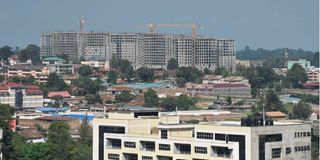
A view of Pioneer Affordable Housing project in Eldoret City, Uasin Gishu County under construction, towering above surrounding buildings on August 26, 2025.
Collections from the State’s housing development levy surged past expectations in the year ended June 2025, reflecting stronger compliance and enforcement of the monthly charge on pay slips that has stirred legal, political, and economic debate.
Fresh data shows the Kenya Revenue Authority (KRA) collected Sh73.2 billion in housing levy receipts in the financial year 2024/25, outpacing the Sh63.2 billion set by the National Treasury.
This means the government mobilised Sh10 billion more than it had anticipated, according to data provided by the Treasury, achieving 115.82 percent of the target.
President William Ruto’s government has maintained a firmer stance on compliance with the housing levy despite spirited resistance from critics who have questioned its legality, fairness, and the speed at which the proceeds are being deployed.
Employers are required by law to deduct 1.5 percent of gross monthly pay from employees and match the contributions towards the housing levy.
Despite the robust inflows into the affordable housing fund, absorption of the cash has lagged due to the phased nature of construction projects, which take time to plan and implement.
As a result, nearly half of the proceeds have been temporarily invested in Treasury bills — short-term government securities that mature in between three and 12 months.
A report tabled in Parliament by the State Department of Housing and Urban Development in May, for instance, revealed that more than Sh30 billion of the levy proceeds remained unspent at the time, and were sitting in the Treasury bills.
The Affordable Housing Board, a State agency that oversees development of houses and their off-take, has defended the move, saying it ensures the funds are safeguarded and productive while awaiting deployment.
“It is not prudent, even as a government, to have money lying idle in an account. The money is safe, fully invested in government securities, and the accounts we are operating are CBK accounts, which have full sight of the government on every expenditure,” the board acting chief executive Sheila Waweru said in an interview earlier this year.
“So we are able to put the money in Treasury bills as a manager of the [affordable housing] fund, and it brings in additional money, say Sh2 billion, and that enables us to put up more units, which we will not do if the cash was staying in an account idly. This is a measure for prudent management of the fund.”
The collections last financial year marked a 35.06 percent jump over Sh54.2 billion netted in the first year of implementation ended June 2024. The collections that year narrowly missed a target of Sh54.6 billion by 0.76 percent or Sh415 million.
The collections in the debut year were, however, paused for three months between January and March 2024 after the deductions from employees — whether on permanent and pensionable terms or contract-based engagements — were initially declared unconstitutional by the courts in late 2024.
Judges found the levy discriminatory because it applied only to workers in formal employment, thereby creating unequal principles under Employment law.
The ruling prompted lawmakers to move swiftly and enact the Affordable Housing Act, 2024, to cure the defects identified by the courts.
President William Ruto signed the Act into law on March 19, 2024, paving the way for KRA to resume the deductions after the scope was expanded to include workers in the informal sector.
The Affordable Housing Act 2024 has also ring-fenced the housing levy funds to be spent on building houses under a special fund to avoid diversion to other projects in the past, where cash meant for stabilization of fuel prices was, for example, spent on road projects.
The levy is a cornerstone of Ruto’s flagship Affordable Housing programme, aimed at narrowing Kenya’s housing deficit, estimated at 200,000 units annually.
One and a half years after the law was enacted, however, there are still no clear modalities for collecting the levy from informal sector workers, who make up more than 80 percent of Kenya’s labour force.
“There are people in the informal sector who are already contributing, just that we don’t have everybody contributing, mainly because it is about self-declaration of your income. This is something that we are trying to work on with KRA and ensure that everybody pays,” Ms Waweru said in February.
In the current financial year ending June, the Treasury has set a target of Sh95.84 billion, according to budget books.
The government is, under the Affordable Housing Programme, building social housing units [bed-sitters] targeted at persons earning less than Sh20,000 per month, affordable housing for workers with income of between Sh20,000 and Sh149,000 and affordable middle-class housing for those earning more than Sh149,000.