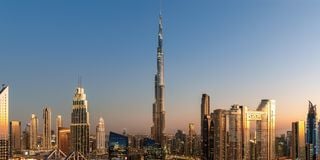
A woman in the lift asked, “First time in Dubai..? You should check out the 44th floor.”
After an exhilarating day at Hatta Wadi, an adventure park 134 kilometres from my base at the Hilton Dubai Al Habtoor City, every muscle in my body was screaming for rest and recovery. The bike rides, wall climbs, and kayaking had left me properly spent.
What I craved that evening was good unwinding. The kind that comes with good whiskey, soft jazz, and perhaps some deep house floating on the breeze. Being in Dubai in the so-called ‘winter’ season, that window between November and March when the heat finally relents, the thought of a rooftop evening felt perfect.
But Dubai isn't Nairobi. It’s not the kind of place where your favourite drink casually sits on a counter waiting for you. You won't find bottles of spirits casually displayed on shop shelves here.
That doesn’t mean you can’t find it; you just need to know where to look. The city's relationship with alcohol is more discreet, more intentional. To indulge, you must head to a licensed venue, usually tucked inside a hotel or restaurant.
The 44th floor felt like a slice of home, Nairobi after dark. The familiar hum of nightlife wrapped around me, a nightclub buzzing on one side, a restaurant and lounge pouring every kind of drink you can think of, and even a cigar lounge for the aficionados.
This carefully curated scene is part of Dubai's broader courtship of tourists from Africa. Over the past three years, Dubai has been deliberately shifting its gaze toward Africa, particularly Kenya and South Africa in a renewed push to attract more travellers from a market the Dubai Department of Economy and Tourism (DET) admits it previously under-engaged.
"We simply weren't as active in the African market as we are now," Bader Ali Habib, Director of Proximity Markets at DET, told BDLife.
“Now we are directly engaging stakeholders such as tour agents, launching campaigns like Visit Dubai, partnering with top African influencers, having special customised Visit Dubai social media handles and blogs for Africa with information on the kind of places they would want to visit, activities they like, because there is still a lot of lack of knowledge of what African tourist can do in Dubai."
Yet for all this progress, Habib is quick to point out that wooing African travellers hasn’t been without hurdles. And the biggest culprit, he says, is misinformation.
“The biggest challenge we’re facing from Africa is the misconception many travellers have about Dubai. We’ve realised there is so much wrong information circulating in the African market.”
According to him, these misconceptions are surprisingly persistent.
“People ask, is alcohol even allowed? Are there nightclubs and lounges? Can women drive? What about dress codes, can you wear a bikini at the beach? Can you even visit during Ramadan? “All these questions keep coming up, and the answer to all of these is yes. But the majority of African travellers don't know that."
Habib acknowledges that some of these concerns were once rooted in truth, but Dubai has evolved dramatically, shedding old restrictions to align with global social norms.
“Yes, at some point, which is more than a decade ago, some of these restrictions existed. But not anymore. Even the work week has changed. Dubai used to operate from Monday to Thursday, but now weekends fall on Saturday and Sunday, just like much of the world. There’s also this perception that the city shuts down early because of these supposed restrictions. This is exactly why we're investing so heavily in awareness campaigns—to demystify all these wrong, outdated perceptions.”
Getting the messaging right, Habib believes, could unlock a surge in African tourism as Dubai continues its quest to rank amongst the top world destinations.
According to Pamela Moige a travel agent with Bonfire Adventures, in recent years, selling Dubai as a destination to Kenyans hasn't been much of a problem.
"I think a large chunk of the 4 per cent from the Dubai tourism data has to be Kenyans, and South African because Dubai is a hotcake destination for us. We receive a lot of enquiries, we don't struggle selling Dubai because a lot of Kenyans want to visit, we don't need to convince them,'' Ms Moige says.
She, however, notes that, this wasn't the case initially.
"About six years ago it wasn't easy selling Dubai as a destination, and that's because being an Emirate, an Islamic nation, Kenyans were a bit sceptical about it because of the laws and things like that, they didn't know what to expect. But that has drastically changed, also influenced by the feedback of the sheer number of Kenyans and other Africans who live and work there." Ms Moige notes.
Desert safari and night beaches
Dubai is also keenly aware of the competition it faces for the African traveller, with the competition sitting much closer to home. Kenya, Tanzania, and South Africa remain top favourites for Africans seeking adventure, culture, or an easy escape.
Just last year, Tanzania was crowned Africa’s Leading Destination, while Cape Town took home the title of Africa’s Leading City Destination at the World Travel Awards.
“In Africa, when we look at our competing destinations, South Africa tops, followed by Tanzania and then Kenya. During safari season, the trend shows African travellers prefer staying within the continent. Tanzania, Zanzibar, and Kenya all benefit massively during this time. So our job is to present alternatives, to show the African traveller what else they can experience, like desert safari activities like camel rides, dune buggies, dune camping, dune bashing or sand boarding, basically new adventures they can't find elsewhere.”
And even with the postcard-perfect beaches of Cape Town, Zanzibar or the Kenyan coast, which continues to rank among the world’s most attractive shoreline destinations, Habib insists Dubai offers something different, something competitive.
“There is no doubt about the stunning beaches in all these African destinations, but Dubai has its unique place among the beaches”, he says.
He points to one example that surprises many first-time visitors- the night beaches.
“Think of night beaches as an alternative, something that many destinations globally don’t always offer because safety and security aren't guaranteed. Dubai consistently ranks among the safest destinations globally. Picture yourself on the shore at midnight, your children are playing freely nearby, and you're not constantly looking over your shoulder. You can actually relax, genuinely unwind, because you know everyone is safe."
Shopping, Habib adds, is another of Dubai’s strongest lures for African travellers.
“Today, we rank among the world's premier shopping destinations right up there with London and New York. Our focus now is on making sure this message reaches the African market. And to make it even more attractive, travellers can shop in Dubai at significantly discounted rates, especially during summer, when the city experiences its low-peak season.”
These efforts, he explains, are intentional, designed to compensate for factors Dubai can’t change by crafting experiences compelling enough to balance the scales of probabilities.
“Proximity plays a very key role in travel decisions. For example, South Africa to Dubai is an eight- to nine-hour flight. You lose at least two days just travelling in and out, which makes the trip slightly more expensive compared to flying to Tanzania or Kenya, which are much closer. So if you’re planning a short five-day holiday, you’re more likely to choose Kenya or Tanzania. For Dubai, most travellers find it makes more sense if they can stretch it to a seven-day trip. That's why the experiences we try to curate have to be worth it, enough to make that extra distance and cost feel inconsequential.”
Free Stopover Visa
To further entice African travellers, Dubai’s tourism department recently introduced a pilot programme offering a free 98-hour visa as part of a deliberate push to encourage longer stopovers and extended itineraries in the Emirate.
“Another observation we made is that whether African travellers were journeying within the continent or abroad, 86 per cent chose Dubai as their stopover. However, most of them never stepped out of the airport. For us, that was a missed opportunity,” he says.
To capitalise on that, the Dubai tourism department partnered with Emirates Airlines and, over the past few months, rolled out a complimentary four-day visa for passengers travelling from South Africa via Dubai.
“So if you're connecting through Dubai and flying with Emirates, the airline absorbs your stopover visa costs. We want those stopover hours to become discovery hours because our goal is to grow African visitation by 10 per cent, and this is one of the most direct ways we are doing it."
As for Kenya, the Bonfire travel agent, observes that processing of Dubai Visas is seemless however in recent months there has been a few Visa restrictions for certain Kenyan demographic.
"For our market there is very minimal Visa restrictions for Kenyans wanting to visit Dubai, as compared to what we know or here of West Africa notibaly Nigeria. And that explains why we have alot of Kenyan departures to Dubai. Family Visas and people above the age of 40 applications are always approved in due time. The only Visa restriction that we have noted that has been introduced recently by the Dubai government to Kenyans, is if the application is of someone who is single and is of below the age of 40, majority of those applications are always declined. We are not sure why, but there is an observation that there is fear many who fall in this demographic may visit and never return once their Visas expires." Ms Moige notes.