Time flies with great content! Renew in to keep enjoying all our premium content.
Prime
Government to directly manage US funding of Kenya’s healthcare
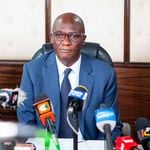
Ouma Oluga, Principal Secretary, Ministry of Health during a press briefing at Jaramogi Oginga Odinga Teaching and Referal Hospital, Kisumu on August 09, 2025.
Kenya and the United States are set for a new partnership that will change how donor-funded health programmes are managed.
The five-year Memorandum of Understanding (MoU), which is currently in its final stages of refinement, introduces a more integrated, accountable, and sustainable model for Kenya's public health system.
The initiative is expected to restructure how HIV, tuberculosis, malaria, and maternal health programmes are delivered.
Previously, America provided funding through USAid, which implemented programmes via separate structures running alongside Kenya’s public health system, such as donor-managed clinics, project-specific staff contracts, and independent supply chains for medicines.
Under the new arrangement, the Kenyan government will manage the funds and oversee programme implementation directly, while the US continues as the primary donor.
"The whole essence about it is that they [US] want to enhance efficiency in the way they are doing funding. They also want the government to be at the forefront. That means the government is the one that is leading," said Dr Ouma Oluga, Principal Secretary for Health, in an interview with the Business Daily.
According to Dr Oluga, this MoU is expected to be completed by the end of the month following an agreement between President William Ruto and US Secretary of State Marco Rubio on the sidelines of the UN General Assembly (UNGA) in September.
"This is a mutual partnership anchored in shared priorities. The previous model worked for its time, but Kenya's needs have evolved. We can no longer run parallel systems inside public facilities," Dr Oluga told the Business Daily.
"Most policy components have already been cleared by the Ministry of Foreign Affairs, leaving only legal language to be finalised."
According to Dr Oluga, who is at the centre of the shift, the partnership will focus on six key areas, including ensuring the continuity of frontline services such as HIV, TB, malaria, and maternal and child health, as well as strengthening outbreak response.
It will also include support for the health workforce and improving access to essential health products and technologies.
The negotiations come just two months after the US government scrapped the USAid's direct funding model after imposing a 90-day halt under a controversial executive order affecting foreign organisations.
While some essential services continued through temporary arrangements, many USAid-financed programmes remained unfunded, exposing Kenya's vulnerability to external funding systems and putting over 1.4 million people who depend on uninterrupted HIV treatment, and millions more who require TB, malaria, and maternal health services, at risk.
However, Dr Oluga noted that patients have not missed their HIV medication during this period.
"The government had to step in quietly and fill the gaps," he said, adding that the six-month disruption exposed deep structural flaws in how donor-funded programmes had been operating.
Dr Oluga noted that the partnership focuses on achieving outcomes rather than just completing activities. Key performance indicators include a 97 percent viral suppression rate among individuals living with HIV.
It also aims to enhance disease surveillance, support for healthcare workers, reliable supply chains for essential medicines, improved data systems, and long-term sustainability efforts.
An estimated 1.378 million Kenyans are currently living with HIV, with 97 percent receiving treatment through a network of over 3,500 treatment sites.
Similarly, Kenya has achieved remarkable progress, with 98 percent of people living with HIV aware of their status and on treatment, and 94 percent achieving viral suppression.
Unfortunately, the country still faces 355 maternal deaths for every 100,000 live births, translating to approximately 6,000 preventable deaths annually, or about 16 women dying every day.
With concerns among healthcare workers who previously depended on donor-funded contracts, Dr Oluga said the most severe disruptions already happened during the USAid wind-down earlier in the year.
"The worst is behind us. This new partnership is not designed to cut jobs but to stabilise services and prevent future shocks to the workforce," he said.