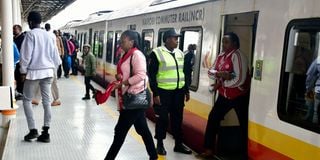
The Nairobi-Embakasi train route is now the most booming within the Nairobi Commuter Rail (NCR) network, with revenues jumping 36.3 percent to Sh17.94 million in the six months to June this year, driven by a surge in passenger numbers.
Official data shows that revenues on the route outgrew those on the Nairobi-Ruiru route, which rose three percent to Sh16.2 million from Sh15.73 million.
For years, the Nairobi-Ruiru route has been the most profitable, but has now relinquished this dominance to the Nairobi-Embakasi route.
Some 321,659 passengers used the Nairobi-Embakasi route in the six-month period, an increase of 22 percent from 263,736 in the same period last year. Meanwhile, those using the Nairobi-Ruiru route rose marginally to 301,909 from 296,562 in the same period.
In recent years, the NCR has become critical for tens of thousands of residents and workers travelling to the capital from neighbouring towns.
The Kenya Railways Corporation (KRC) operates trains on 11 routes linking the Nairobi central business district with towns such as Kahawa, Ruiru, Embakasi, Athi River, Kikuyu, Limuru and Nanyuki.
Other towns served by the trains include Lukenya and Syokimau. KRC also operates diesel multiple units on the Nairobi-Syokimau and Nairobi-Embakasi routes.
Revenues from all the routes jumped 12 percent to Sh74.87 million in the six months to June this year compared to the same period last year, while passenger traffic grew 3.9 percent to 1.26 million.
Higher passenger numbers and growth in revenues for the trains signal a further squeeze for the public service vehicles (PSVs) plying the same routes.
The lower fares charged by the trains have been crucial in pulling thousands of workers and residents to use them instead.
Passengers pay a maximum of Sh80 for a one-way trip on the trains within Nairobi, which is lower than the Sh100 or more that PSVs charge for the same routes.
KRC revived the trains on most of the city routes during the previous administration of former President Uhuru Kenyatta, as the agency sought to grow its revenues and help address the city's public transport chaos.
The agency has linked the metre-gauge railway to the standard-gauge railway at the Syokimau terminus, enabling passengers travelling from Mombasa to Nairobi to travel seamlessly.
KRC is seeking to upgrade seven commuter lines and acquire new trains, looking to capitalise on the increasing popularity of the trains in Nairobi and surrounding towns.
Under the World Bank-backed Kenya Urban Mobility Improvement Project, the agency will acquire high-capacity trains and roll out an automated fare collection system for the city trains.
Last year, Kenya applied for a $670 million loan from the Bretton Woods institution for this project.