Time flies with great content! Renew in to keep enjoying all our premium content.
Prime
Electrocutions hit record 122 amid increased power theft
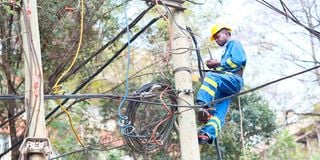
An employee of the Kenya Power and Lighting Company (KPLC) conducts repair and maintenance work along State House Road in Nairobi on November 15, 2025.
A record 122 persons were electrocuted in the year that ended June 2025 amid increased illegal connections and encroachment on power lines, turning the spotlight on the level of public safety awareness and adherence to the law.
National electricity distributor Kenya Power revealed that the number includes 115 members of the public, five employees and two contractors as the number rose from 118 a year earlier.
The increased fatalities shine the light on illegal connections, encroachment on areas where the transmission lines pass and also faulty wirings, which have left Kenya Power racing to scale up public awareness in a bid to address the risks.
Kenya Power can only compensate victims when fatalities are caused by negligence from its side, meaning that families of most of the 122 people killed are not likely to be paid.
“Unfortunately, there were 122 fatalities attributed to electrocutions and operational-related accidents, comprising 115 members of the public, five employees and two contractors,” Kenya Power says in its latest annual report.
The utility has for years grappled with the headache of illegal connections and people encroaching on power lines, especially in informal settlements, in breach of the Energy Act 2019.
Kenya Power data shows that out of the deaths in the review period, 21.7 percent were caused by faulty wirings, 12.2 percent due to encroachment on power lines and 11.2 percent were caused by illegal power connections.
Collapsed Kenya Power lines caused 10.5 percent while vandalism led to seven percent and third-party interference (4.3 percent). Illegal electric fences, acts of ignorance and protection gaps are the other causes of the fatalities.
However, scores of other victims especially those who have breached the law and encroached on wayleaves of high-voltage lines, those who have illegally tapped electricity and others with faulty connections are exposed in case of electrocutions.
Illegal connections lack safety installation standards and besides exposing the public to the risk of electrocution, they also lead to overloads on transformers, thus exacerbating the risk of an unstable grid.
An unstable grid has a higher risk of power surges or outages, which in turn creates a risky environment for Kenya Power engineers working to maintain the system.
Besides the risk of electrocution, power theft in the illegal areas continues to deny Kenya Power millions of shillings in electricity sales.
Vandalism is one of Kenya Power’s biggest headaches and a booming demand for copper and scrap materials in the region has been cited as a major driver of the crime.
Encroachment, especially in urban areas has continued unabated despite the heavy penalty contained in the Energy Act, 2019. Infringing on wayleaves or vandalising power lines are categorised as economic crimes with a fine of not less than Sh5 million or to a term of imprisonment of ten years or to both.
Kenya Power has in recent years faced mounting lawsuits as families of persons electrocuted seek justice on grounds that the deaths were caused by negligence from Kenya Power.
For example, the High Court in Mombasa ordered Kenya Power to pay Sh3.2 million to the family of a woman who was electrocuted by a fallen power line in Mombasa.
The State-owned electricity distributor had early last year been ordered to pay another victim Sh14.2 million for electrocution. Some of the lawsuits have hit the utility due to the heavy compensation package that the courts have awarded victims.
The firm was in 2021 ordered to pay Sh22 million to the family of a girl whose both hands were amputated after she touched live electric wires. Kenya Power lost an appeal to lower the compensation package.
The cases highlight the financial hit that Kenya Power takes whenever negligence from its staff leads to fatal electrocutions.
Families pushing for compensation for their kin who have been electrocuted must demonstrate the culpability of Kenya Power in those fatalities.
Vandalism, encroachment and flawed connections are rampant problems in the informal settlements even as Kenya Power continues to spend millions of shillings in sensitizing Kenyans on the deadly consequences.
Kenya Power routinely conducts public safety campaigns and undertook 648 such meetings in the year ended June 2025, a rise of 36 percent from 476 a year earlier.