Lilian Ombui bought her house in 2019, and inherited what most homeowners in Kajiado get. The compound was completely bare and dry. It had not just poor soil, but literally no usable soil at all. The ground was so dusty that it could not support even the most basic plants without serious intervention.
While most of her neighbours filled their compounds with cabros, Lilian had a different plan.
On the 40x80 plot, she started with basic landscaping and years later her compound is so green that it would be hard to imagine that it is Kajiado.
“My neighbour was the first inspiration. Despite having a high mortgage, her priority was to build a seating area in her garden. I thought, 'Why not?' The space was sitting there unused."
“I had to purchase an entire truck of soil,” Lilian recalls. “That alone costs about Sh18,000. Then I enriched it significantly with manure and compost to make it viable for planting.”
"People want to skip this step and go straight to planting beautiful flowers," Lilian observes. "But without good soil, those beautiful plants will struggle and die. Invest in soil first, and everything else becomes easier."
Soil care isn't a one-time event in Lilian's garden. She consistently top-dresses planting areas, especially after dry seasons, doing all this maintenance work herself. "This ongoing fertility management has been crucial for maintaining the lush appearance even in dry conditions," she notes.
Her kitchen waste, grass clippings, and manure all find their way back into the soil.
Located in Nkoroi,on the Kiserian-Isinya road, Lilian has transformed what was once a dead space into a compact home garden, that real estate agents use photos of her property to market other houses in the estate.
"When my neighbour wanted to sell their house, the real estate agents used photos of my garden to market their property," Lilian recalls with a smile. "The photos went viral."
The incident revealed both the uniqueness of what she had accomplished and the market demand for it. In an estate full of paved yards, her lush garden stood out.
Flower garden at the home of Lilian Ombui Andita in Rongai on November 15, 2025.
Photo credit: Wilfred Nyangaresi | Nation Media Group
Her background in architecture and interior design gave her a unique advantage in creating the transformation.
Six years after buying the house, which sits in a gated community, for Sh7.5 million, someone recently offered her Sh10 million, a Sh2.5 million appreciation driven largely by the transformation of her garden.
However, these figures only hint at her successful gardening journey in a small space. Creating a lawn in the dry conditions was one of Lilian's biggest challenges.
She had tried three different types of grass before finally settling on the current one.
The first was the Zimbabwe grass, which she chose because of its beautiful, thick carpeting effect.
"It looked stunning in the areas with full sun," she recalls. "But it struggled terribly in the shade. The inconsistent growth made my lawn look patchy, and it also needed so much water to maintain that lush look."
Next was the Arabica grass, which turned out to be her most stressful experience. "Arabica looked elegant when it was thriving, but it was prone to diseases. Brown patches would appear, and they needed immediate treatment. It required constant care, specific fertilisers, and a lot of watering," says Lilian.
"I felt enslaved by my lawn," she admits. "It was supposed to bring me peace, but instead it brought stress."
Her solution came in the form of Pemba grass, which has transformed her lawn. "Pemba is a game-changer for dry areas," Lilian says.
"Even when it looks stressed during dry periods, it bounces back quickly with watering. It tolerates shade better than Zimbabwe and has no disease problems."
The installation cost her Sh10,800 for six bags. "It took about three weeks to fill in properly with consistent watering," she notes. "The difference is that I'm no longer enslaved by my lawn. I can enjoy it."
For watering, she relies on her own water supply, from a 5,000-litre tank, and waters her entire garden at least three times per week.
Reading the plants
"I've learned to read my plants. When the grass blades begin to fold or lose their elasticity, they're telling me they need water."
The discipline required for consistent watering is the biggest barrier for many would-be gardeners.
"People get excited about plants but underestimate the commitment. If you can't commit to regular watering, stick with extremely drought-tolerant species or don't garden at all," says Lilian.
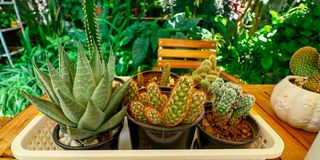
A collection of various small potted succulent plants and cacti, pictured at Lilian Ombui Andita's home in Rongai on November 15, 2025.
Photo credit: Wilfred Nyangaresi | Nation Media Group
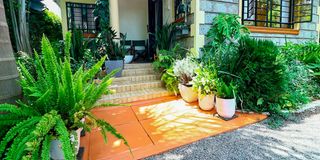
Walk through Lilian's garden today and you'll encounter over 30 different plant varieties, each chosen for its ability to thrive in specific microclimates within her small plot.
In shaded areas, she's planted various ferns, philodendrons, snake plants, and spider plants. "Ferns are surprisingly drought-tolerant once established," she says. "And snake plants are nearly indestructible, perfect for beginners."
For sunnier, drier spots, she relies on Song of India, Chinese money plant, Italian cypress, and crotons. These plants can tolerate intense sun and limited water due to their thicker leaves, waxy coatings, or deep root systems, which allow them access to moisture other plants can't reach.
She has screened the water feature with beautifully trimmed bamboo.
One of her most unique additions is Spanish moss, also known as old man beard, an air plant that requires no soil. "People sometimes think it's dead coconut husk, but no, it's alive!" she laughs. "You just mist it with water. It gets its nutrients from the air. They're rare and often used in upscale hotel decorations."
Ironic failure
While Lilian has always enjoyed success, she reveals an ironic failure.
"I've killed some succulents, ironically," she admits. "In a garden where you're watering frequently for other plants, succulents easily get over-watered. I now keep them in a separate, drier zone."
She's also learned about plant compatibility. Some species don't belong together because they have conflicting needs.
"You can't put a moisture-loving plant next to a drought-tolerant one and expect to water them the same way. Either one will get too much water or the other will get too little."
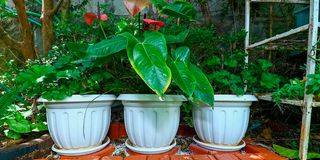
A view of the flower plant at the contemporary backyard at the home of Lilian Ombui Andita in Rongai on November 15, 2025.
Photo credit: Wilfred Nyangaresi | Nation Media Group
Her secret lies in strategic design techniques that make the space feel much larger than its actual dimensions.
"Vertical growing has been crucial," she explains, pointing to climbing vines on walls, hanging plants from her custom-built pergola, and tiered pot arrangements. "When horizontal space is limited, grow up."
Beyond aesthetics and property value, Lilian's garden has created a tangible improvement in her family's quality of life, one she didn't fully anticipate when she started.
"My previous apartment felt like an oven," she says. "But this garden has created a microclimate. Temperatures here feel cooler than the surrounding area."
Shade from taller plants has created a comfortable outdoor space, protecting it from direct sun.
"I spend mornings having breakfast in the garden and evenings relaxing there. It's become the heart of our home," she says.
She invests about eight to 11 hours per week in maintenance.
Unlike many gardeners who hire help for routine maintenance, Lilian handles everything by herself.
"I do all the maintenance myself—the watering, plant care, arrangement, even the mowing and pruning. The hands-on involvement is crucial. You develop an intimate understanding of each plant's needs."
"You can't delegate the details," she says. "Hired help might water on schedule, but they won't notice the subtle signs that a plant is struggling or needs adjustment. That observation comes from daily interaction."
She now offers landscaping services to other homes in her estate and beyond, sells plants from her propagation nursery, and provides garden design consultations.
"People see what's possible and want it for themselves. But they don't know where to start, or don't have time for the trial and error I went through. That's where I come in."
For consultation clients, she visits their property, assesses soil and light conditions, and creates a tailored planting plan with species suited to their specific microclimates. For full landscaping clients, she manages the entire transformation from soil preparation to plant installation to maintenance training.
"I've learned to propagate many of my plants, creating a small nursery in my garden," she explains. "When I see a plant doing well, I propagate it to sell or share. I also sell pots and containers, and custom soil mixes."
Six years later, Lilian considers her garden a work in progress rather than a finished project. The learning continues, the improvements accumulate, and new ideas keep coming up.
"I'm planning a gazebo with a fireplace for entertaining, and a dedicated kitchen garden behind the house," she shares. "Right now, I grow vegetables and herbs in pots, but I want a proper space for that."
When neighbours with mansions visit, they are amazed. "They have bigger houses, but they don't focus on the outside. They've created concrete jungles."