This past weekend, orchid collectors and enthusiasts gathered for the much-anticipated Annual Orchid Show at the Sarit Centre.
This year’s blooms were nothing short of lush, vibrant, and bursting with colour. Shades of purple, yellow, white, and green transformed the exhibition hall into a miniature jungle.
The theme for this year, Orchids Through Legends, inspired exhibitors to honour their heroes through creative displays.
Growing orchids is often regarded as an elegant and sophisticated form of gardening, perhaps because these delicate flowers are true gems when in bloom, their beauty highly sought after by collectors.
The BDLife spoke to several orchid enthusiasts, many of them retirees, who shared how nurturing orchids brings them calm and keeps them in their element.
Retired lawyer turns orchid conservationist
Growing orchids has become a beloved hobby for many Kenyans. Among them are retirees who are using the art of orchid cultivation not only to find peace but also to build communities around shared passion.
Alexandra Kontos first interacted with orchids in 1984 when a friend gifted her some orchids. Her collection has now grown to over 2,000 orchids of different varieties that she grows at her home in Nairobi. She says that the most important thing for her is the conservation of orchids.
“We are conservationists, and our principle is that we must not collect orchids from the wild. The aim is to propagate the orchids that we have. It is unfortunate that some pick orchids from the forests to sell and end up destroying our natural habitat,” she says.
After retiring from the corporate world nine months ago, Mrs Kontos, who co-founded Walker Kontos Advocates, has found solace and joy in tending to her orchids. “My orchids help me keep my sanity. I now spend a lot of time in the orchid house caring for them.”
Currently, she is investing her time in helping plan for the publication of the Kenya Orchid Society’s second book on Orchids. “With the book, we want to showcase our orchids. The book will be for sale internationally,” she says.
What brings her the greatest joy, however, is the increasing number of young Kenyans showing interest in orchid growing. “I’ve never seen so many young people attend our shows. We also have young people on our committees in the society, and they’re doing incredible things,” she says.
Mrs Kontos, now 80, says her love for learning has shaped her journey as an orchid grower. “My profession required a lot of reading, and I brought the same discipline to orchids. I’m self-taught, but I read extensively to understand them,” she says.
She says that when taking care of her orchids, she is keen not to overwater them. “You must be careful; that is the main reason people kill orchids. Some species need more work than others, depending on where they come from and the microclimate you create. Labelling is also very important. A plant without a name is not a plant,” she tells us.
A member of the Kenya Orchid Society since 1984, Mrs Kontos says the group has become her and her husband’s social circle.
“I used to work from 8am to 6 pm every day, so I didn’t have much of a social life. The society is now our community. We meet once every month. I have also trained many members. Some started as beginners and are now judges,” she says, adding, “For this year, my stand was inspired by Bob Marley. It was my husband’s choice.”
“I chose Bob Marley because he was great. He became a legend out of nothing. Unfortunately, he died too early. He also comes from Jamaica, which is an orchid-growing country,” Dmitri Kontos chimes in.
He adds, “There is no university where you learn how to grow orchids. You have to practise, observe and trust your instincts. It also helps if you have green fingers. As a couple, we are lucky because we have the same hobby. We enjoy doing it together.”
Anne Eriksson: From boardroom to bloomsroom
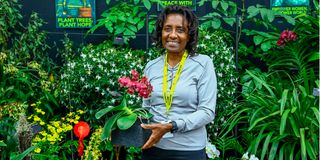
When Anne Eriksson retired as the CEO of PricewaterhouseCoopers, she had her orchids, having started her collection in 2014. “I found that for a person like me who has a busy job in a hectic corporate space, tending to orchids helped me calm down. I’m the one who pots my plants. Just being close to nature allowed me to slow down and find balance,” she says.
For Anne, orchids have become more than just a pastime; they’ve been a source of life lessons.
“Each species is unique. If you tend to it properly, it may flower beautifully, but sometimes, it dies on you. That can be humbling. The most exciting part is when you go into the greenhouse and find the bud has come through. Then a few days later, it opens up and you can see the beauty of the flower.”
She adds, “Through the Orchid Society, I have met and made some amazing friends because we share a similar passion. We are almost like a family. We learn from each other and we celebrate one another.”
Anne Eriksson, a member of the Kenya Orchid Society, poses at her exhibition booth during the annual Orchid Society Exhibition at Sarit Expo Center in Nairobi on October 18, 2025.
Photo credit: Wilfred Nyangaresi | Nation Media Group
Anne adds that orchid collection is also a hobby that she shares with her husband. “He is an agronomist, so he is very good with the do-it-yourself tasks. He has been my anchor when it comes to the infrastructure around our orchids. There are trips we make that are sometimes just centred on orchids.”
Since her retirement in 2018, Anne has doubled her orchid collection to over 600 plants. She still serves on several boards as a non-executive director. Are there bits of her corporate life that she has brought into her orchid growing?
“Some of the skills that you acquire during employment don't evaporate because you have retired. You strive for excellence and are resilient. You are tenacious and you keep at it until you are perfect. I think those are skills I acquired during employment, and I still draw from them in this world of orchids. Many people said that Anne is a perfectionist. I try to be the best grower I can be. I'm not saying I am perfect, but I strive to be the best I can be,” she says.
On a typical day, Anne spends three or four hours with her plants. “I want to do it during the morning hours when it is not very hot. Every few weeks, I'll want to repot my plants because some need to be repotted or subdivided as they become too big. My gardener helps me with the watering on a day-to-day basis, so I would normally not do the watering. We fertilise twice a week,” she says.
Her advice to beginners is, “Orchids will give you as much as you give them. The more you invest in them, the more they will give. Look out for pests, diseases, whether they are happy or in need of repotting.”
A beginner’s journey: Hannah finds calm among orchids
For Hannah Gitonga-Mwangi, the love for orchids began nearly three decades before she ever owned one.
My story with orchids started in 1996 when I was working with Mrs Kontos. Every year, we would attend the orchid show. I was stunned by their beauty and elegance the first time I saw them.
At the time, I understood that it takes a bit of time, effort and money to grow them. I put a mental note for myself that when I grew up, I would have my own. So three years ago, I felt ready to take up this challenge. I was at a place where my children were growing up and were off to high school, and I had a bit more time for myself,” says tge 52-year-old advocate.
She joined the Kenya Orchid Society in 2022. “At my first meeting, I was completely overwhelmed. Everyone was using scientific names, and I was lost, but I managed to catch up, and it has been quite a journey for me. Now I have over 150 orchids. What is exciting is that there is so much information online.”
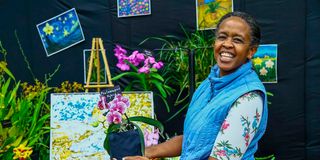
Exhibitor Hannah Gitonga Mwangi poses for a photo during an interview at her exhibition booth during the Kenya Orchid Society Exhibition at Sarit Expo Center, Nairobi, on October 18, 2025.
Photo credit: Wilfred Nyangaresi | Nation Media Group
Hannah says that orchid growing has taught her patience. “Waiting for your flowers to bloom can be a heart-wrenching experience. When I first started, I would go online to look up images of the orchids I had bought, to see what they might look like in bloom.”
As retirement draws near for her, Hannah says that orchids are part of her long-term retirement plan.
“I can already see how I will spend my time. Having a hobby helps build muscle, and you have a lot more cell growth in your mind. I took care of my father, who had Alzheimer's, and it was amazing to see what all the plants would do for him and his health. Currently, I set aside a day, Saturday or Sunday, to work on my orchids. It’s my time to connect with nature, reflect, and recharge,” the founder of Gitonga Mwangi & Co. Advocates says.
Anand Savani, the chairman of the Kenya Orchids Society, attributes the vibrant and lush display of orchids experienced this year to the cool temperatures experienced in the country.
“ This year we have had a very cool climate. You will see that a lot of the orchids which have bloomed this year are cooler climate orchids. You will notice that we have a lot of cymbidiums and oncidiums in bloom this year. Additionally, normally we usually have the show one week later, but this year we have done the show one week earlier, which has allowed us to display nice blooms too. Every year, you will see a different range of flowers, depending on the weather and climate change,” he explains.