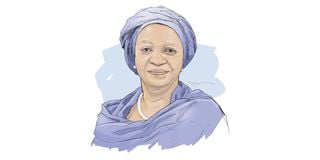
United Nations Nairobi Director-General Zainab Hawa Bangura spoke to the Business Daily on the planned expansion of the global body in Nairobi including what makes Kenya’s capital compelling for the organisation resulting in a wait list for agencies looking to post their staff and regional offices to the city.
Nairobi is set to host three new offices from next year while several UN agencies are moving their staff here; would the city potentially end up as the headquarters for the organisation?
This would be a decision of the member states. It was agreed that New York would become the headquarters during the UN's founding. Over time we had other headquarters in Geneva, and then Vienna.
A demand for a headquarter in the global south saw Nairobi come into play given it had a large UN compound already.
Any decision to the effect of how member states handle themselves must be taken by members. The Secretary General of the UN (Anthony Gutierrez) made the decision to expand in Nairobi seeing that this headquarter has become so important for the organisation.
There is an estimated increase of staff by 800, will all these be expatriate workers?
I don’t think we have any office with more international than local staff. Most of our staff are Kenyans and that speaks to the opportunities available for citizens. Some international staff will move to Nairobi but there will also be vacancies for Kenyan nationals.
There is a feeling that Nairobi is more efficiently placed to host most UN offices, might we see more agencies moving their staff here or even headquarters over time?
The Secretary General wants to leave the UN on a better footing. Member states are facing financial crises and are reducing their contributions to the organisation. What agencies have found out is that they can find cheaper duty stations where they can spend less to manage.
Agencies such as UN Women, UNFPA and Unicef will keep their headquarters in New York but will move some of their global staff to Nairobi and set up country and regional offices here.
How would you broadly assess the economic impact of the UN expansion in Nairobi?
It would be great if the Nairobi Governor and the National Treasury would do an impact assessment like New York and Geneva did. This can help educate the public. There are a lot of positive impacts across all aspects of the economy, like for myself, I have seven staff that I hire at my house alone outside the UN. In total we are almost 20,000 people: families, spouses and staff.
There is a concern on whether the UN expansion will see locals especially the middle class getting priced out of homes and neighbourhoods’ as more expatriates’ workers move in, is this a fair concern?
I spoke to some people, and they asked if they should put up some high-end apartments. It came as a surprise because UN staff are like you and me. They are not coming to take all the five-star hotels and high-end homes.
Most people don’t have the actual numbers; we don’t have 10,000 UN staff coming to Nairobi, that’s just not possible, we have a limit in how many staff we can accommodate.
Local hires will likely remain in their current homes and that would not change the dynamics.
I hope people are not building tens of thousands of houses and thinking that the UN is coming to occupy them, it’s just not possible. I will be honest with you, if the houses are too expensive, the workers also won’t occupy them.
In New York where we have our headquarters, staff live in Pennsylvania and New Jersey because they also must live within their income. I don’t get a housing allowance, and most staff don’t. You get a salary, and you decide where to stay. If you can afford to take a two-bedroom you take it, if it’s too expensive then they can co-share. I think there has been too much exaggeration.
You have previously served as the Foreign Affairs and Health minister back home in Sierra Leone before taking up this role in 2020, how did that experience shape the role and responsibilities you have today?
I came to Nairobi just before Covid and it was baptism by fire, but I previously dealt with Ebola as Health minister which readied me for the disruption. As Foreign Affairs minister I had to engage with the government.
Today, I am the representative of the UN Secretary General and from my previous roles I know how to articulate our needs to the government and what we are entitled to. I understand what can and cannot be done. I see the background as a blessing in disguise. I am also lucky to work with an amazing team; you cannot do everything alone as DG.
What makes Nairobi so compelling for the UN to warrant a wait list from your agencies looking to move staff and offices here?
The weather is one, the time-zone is second. I come from Sierra Leone which is hot, and I have lived in New York which has winter. Nairobi blends the two. You don’t use heating or air conditioning. My family reminds me that I haven’t been home in two years, but I dread the heat. The time zone allows us to service people efficiently where we can reach everyone within a 12-hour period. It’s very strategic.
Kenya also has highly educated personnel which helps. If you are opening an office here, you don’t need to bring all international staff. You have national staff who can do the job, sometimes even better.
Lastly, we have a fantastic host country relationship where you can pick up the phone and call anybody in the government. When you talk to someone even if they can’t do something for you, it makes a huge difference.