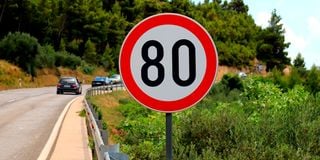
How come the speed limit on town streets is usually 50kph? Why not even slower…or a bit faster? NG
The best traffic systems do have limits in built-up areas that are sometimes higher and sometimes lower than 50kph. But 50 is by far the most common option, worldwide.
Whatever the limit, anywhere, its first objective is to reduce the chances of an accident happening, as part of a package of measures including well-designed and marked roads, roadworthy vehicles, competent drivers, and observance of related laws which set out the human behaviour protocols for a complex and highly interactive mix of different road users.
A secondary purpose of speed limits is to achieve uniformity and predictability in the general flow of traffic, reducing the differential in speeds between one vehicle and another, minimising obstruction and the need to overtake, etc.
If all those conditions prevail, all road users can go about their business smoothly, calmly and safely, and there should be no accidents, even where hundreds of cars and trucks and buses and bicycles and boda-bodas are interacting with thousands of pedestrians in a matrix of junctions and corners and crossings.
In the best systems, to the greatest possible extent, different forms of traffic are segregated (physically separated), with things like dedicated bus lanes and cycle lanes on the road itself, and pavements either side for pedestrians, in a “never-the-twain-shall-meet” manner. Safety is possible without them, but they make the job easier and even safer.
With or without advanced designs, accidents should only occur when something goes wrong — when a vehicle’s brakes fail, a tyre bursts, a driver is intoxicated, suffers a heart attack, or is distracted by texting, when a child runs into the road, or when a cyclist loses balance.
Only then does the third purpose of a speed limit come into effect: not just to avoid a collision, but to minimise the consequences of a crash when it does happen.
Only then does a “specific” speed (30 or 50 or 70) make a significant difference. Perhaps as significant as the difference between life and death.
That’s because the human body has limits to the shock forces it can withstand, and that’s why motorists have seatbelts and airbags inside safety-cell bodwork, why cyclists and boda-boda riders wear helmets (and sometimes gloves and knee-pads). And that’s where regulators have to think even more carefully.
If while walking down the street, you tripped over a square root or a gentle gerund and fell flat on your face, your nose would hit the pavement at about 15kph.
That can hurt, and even cause superficial injury, but the greatest danger and damage will be to your dignity. The human body can take most 15kph impacts with solid objects and will usually emerge almost unharmed.
There is, of course, a difference between a rickety granny and a professional wrestler or rugby player in this respect.
The ouch would be significantly bigger if you fell off the top rack of a bunk bed while dreaming about…whatever you dream about. In this instance, you would hit the floor at about 25kph.
Whether you awoke in a startled daze or in an ambulance would depend on how you landed. The injury is more likely to be bruising than a breakage, and almost certainly not fatal.
Next, you might fall off a ladder while fixing the gutters on your bungalow.
Welcome to the garden…at about 35kph. If your landing place were a concrete patio, you would almost certainly suffer injury, a high probability of a broken bone or two, but again, you would almost certainly survive.
For up to about 35kph, the oops! ouch! and aaargh! Are progressively more painful, but the average body-basic can usually get up and walk away…perhaps with a limp and some interesting vocabulary.
However, that seems to be about the limit of the human body’s built-in crash capacity, and at higher speeds the damage doesn’t just get progressively more severe – it rapidly shifts from fall to…funeral.
Fall onto paving slabs from the gutter of a two-storey building, and flesh will meet cement at 50kph. Breakages move up from possible to almost definite, include a probability of internal ruptures, and you don’t need to be particularly unlucky to kill yourself.
These examples and impact figures are more than just interesting. They are the basis of safety regulations, worldwide. In public places, structures or equipment (parks and playgrounds, staircases, viewing platforms etc.), where a fall will result in an impact of less than 30kph, regulations are few and if it all goes wrong everyone says “bad luck” to both the owner and the user of the stairs.
But where size and height involve a potential fall impact at higher speed than that, design (like safety rails) and conduct regulations (like accompanied children) are strict and mistakes are called “criminal negligence”.
Traffic regulation appears to be an exception to this scientifically based standard.
First recognise that a construction worker hitting the ground at 30kph after a fall, or a pedestrian being hit by the front end of a bus doing 30kph, are much the same thing as far as human muscle, bones and organs are concerned.
And yet, in virtually every field of activity bar motoring, elaborate measures are taken to completely remove the possibility of “falls” greater than 30kph, and anyone who allows such a possibility is liable to prosecution.
Logic suggests that in a city street, where there is constant and close interaction between pedestrians and vehicles, the speed limit should arguably be 30kph.
But a 50kph limit might not be as irrational as it looks. And there are lots of other issues to consider. To restrict all traffic at all times to half (!!!) the current flow rate would adversely affect millions of vehicles all day and every day. And this crawling pace might tempt thousands of pedestrians to take less care and higher risks when crossing the street.
Further, in the event of a pedestrian stepping in front of a car doing 50kph, in almost all instances the driver will at least hit the brakes and swerve to some degree before impact.
So, if the two do collide, the speed at impact will be reduced, the blow may be glancing, and the front of a car, though robust, is not as solid as concrete (where all the shock of the collision will be transmitted to the human).
The front of the vehicle might absorb some of that shock by bending and some more will absorbed as the pedestrian is flung aside (not brought to an instant halt).
So, the fact that the actual speed limit in cities, almost everywhere, not just Nairobi, is 50kph – a potentially lethal velocity – is not as anomalous as it might seem.
If a pedestrian is struck by a bus doing 50kph, there is a possibility that the impact will be fatal, but because that is within the legal speed permitted, in legal terms the verdict is most likely to be “bad luck”.
If a pedestrian steps out into flowing traffic without looking, whether the vehicle that hits him is doing 30, 40, 50, or 60kph, the collision is the pedestrian’s fault.
However, if the vehicle is travelling within the speed limit, the pedestrian almost certainly lives. If the vehicle is travelling above the speed limit, the pedestrian very possibly dies.
So, the pedestrian may be to blame for the collision — but who is to blame for his death?
That’s a question that street and traffic planners, lawmakers, and courts presumably ponder — and motorists too, not just on technical or legal grounds, but as a moral issue.
It is a question that underscores a much underrated aspect of road safety: the moral attitude of people toward road laws and traffic offences.