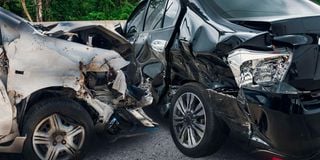
I recently witnessed the aftermath of an accident, where the front corner of one car had hit the middle of the other’s rear end. The following car (made in Germany) had a smashed headlight and dented wing but was still drivable. The car it smashed into (made in the USA) looked as though it had been hit by a wrecking ball! Nothing behind the rear seats was still straight... Are some cars that much stronger than others?
Modern car design does not focus on reducing accident damage to the vehicle. It can be insured, repaired, or scrapped and replaced. The much higher priority is to reduce accident damage to the people inside.
Nowadays, the central cell of the car (the passenger compartment) is strong enough and rigid enough to sustain massive forces without distorting at all, so the people inside it are less likely to be crushed (and the door should still open normally in case the crash is followed by fire or ends in deep water).
But if the entire car was that rigid, the full force of an impact (weight and closing speed brought to an instant stop) would be transmitted to the occupants. Even if they were belted into reinforced seats, at highway speeds, the result could be severely injurious or lethal.
Nowadays, engine and boot compartments fore and aft of the safety cell are purposefully designed to bend and buckle, so a considerable part of the impact force is absorbed before the vehicles come to a complete halt.
The safety cell is thus “cushioned”. Even if the crumpling only adds a few metres and a split second between first touch and final halt, the shock transmitted to passengers is significantly reduced.
And, increasingly, the lesser shock force that remains is further cushioned by belts, airbags, head restraints, side impact bars, collapsible steering columns, soft dashboards, snap-off handles, and engine mountings that ensure engines ripped off their mountings go under the floor, not through the bulkhead to crush the driver’s feet.
It is hard to overstate how big this difference can be. Even in head-on collisions, which in the past would almost certainly be fatal to all concerned, there are numerous instances where collisions that have completely flattened the bonnets and engine compartments of cars right up to the front windscreen, the driver and passengers have not only survived but been able to open the doors, step out and walk away.
And though often shaken and bruised – and well advised to go to the hospital for a check-up – they are alive and likely to fully recover.
The shock-absorbing crumple zones are so effective that some car designs have further “softened” and extended and sloped the first crumple phase to improve the chances of survival even of pedestrians hit by a car.
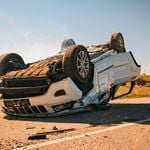
The degree of damage to each car in a collision is not a clear indicator of their relative built-in strength or safety. The overall outcome depends on their weight of the vehicles, the closing speed of impact, the angles and areas of each car that take the main hit, whether they come to a quick halt or deflect and roll...and more.
The crumple zone and safety cell principle is now universal…but not identical. So, tests to calibrate the effectiveness of each brand’s crumple-cushion design don’t smash two cars into each other.
They crash them into concrete blocks at a set speed and various angles and measure the location and degree of body distortion and – above all – the shock transmitted to the data triggers of “humanoid robots” placed inside as driver and passengers.
The process, best known as NCAP, publishes a list of results for many brands and models. If you expect the most prestigious brands and most expensive models to dominate the safety rankings, you might be surprised by the league table. Surf the NCPA website to find out.