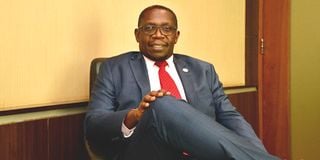
About three weeks ago, lottery jackpot winner Bonnie Kamau said he had to change his telephone number amid life-changing attention from family, friends and even corporations fighting to sell him investment opportunities, including land.
With a record-breaking Sh424,660,618 SportPesa Mega Jackpot win, the Nakuru-based office clerk now finds himself reeling from the unintended pressure of charting a path to manage his sudden wealth.
“There’s been advice from all directions. Some people advise you to invest here, while others suggest spending there. But the best advice has come from my mother, who told me to take a vacation, relax, then decide what to do with my money. That’s exactly what I plan to do,” Mr Kamau says.
Bonnie Kamau celebrates his Sh 424,660,618 SportPesa Mega Jackpot win at JW Marriott in Nairobi on August 13, 2025.
Photo credit: Bonface Bogita | Nation Media Group
He is, however, not the only one facing the dilemma of ‘sudden wealth’. Thousands of individuals caught up in the recent wave of layoffs by corporates in Kenya have also faced a similar predicament on what to do with the ‘sudden wealth’ from their lump sum severance package.
A survey by the Central Bank of Kenya (CBK), for example, shows that one in four companies in Kenya fired permanent employees in 2024, and close to half (42 percent) laid off casual workers amid difficult economic times.
These layoffs often come with lump sum severance pay or optional gratuity payments running into millions of shillings, especially for senior or long-serving employees.
Heirs of rich estates also encounter the pressure of sudden wealth and have to figure out how best to utilise it.
Analysts concur that receiving a financial windfall is never an easy matter to handle for many, because it leaves them facing complex and life-changing decisions, financially and personally.
Njoki Karungu, a human resources expert, advises patience among recipients of financial windfalls.
“Don’t be in a hurry to make decisions or purchases. Take time and seek advice from a finance professional,” she says.
She also warns against oversharing, noting that discretion prevents unnecessary external pressure.
Ms Karungu says the most common mistake people make is assuming that the windfall will last.
“Many get excited, make big purchases, maintain the same lifestyle, and retain debt. A lump sum should be seen as a bridge to the next opportunity, not endless cash,” she notes.
She adds that while employers sometimes offer financial literacy training to staff before releasing retirement or redundancy packages, this is not guaranteed.
“It is simply best practice. Sessions are held regularly for those approaching retirement to increase their financial literacy.”
But history shows such advice is often ignored. Kenyan comedian JB Masanduku has lived through the highs and lows of ‘sudden wealth’ from earnings in the entertainment industry. He recalls how easy it is for artists to overspend once money comes in, often as a way of making up for years of ‘under-appreciation’.
Kenyan comedian JB Masanduku.
Photo credit: Pool
“There’s a temptation to spend it all by nightfall, to prove yourself or to ‘avenge’ the times your craft wasn’t rewarded,” he told BDLife.
“People surround you, glorify you, and before long, discipline goes out the window. Many end up living beyond their means, without financial literacy, and friends or relatives drain them further.”
Mr Masanduku advises young entertainers to take a different path.
“First pause, breathe and lock most of the money away until you’re sure what you want to do with it. Don’t rush into trends or one big investment. Acquire assets that appreciate, like land, before liabilities such as cars. Spoil yourself a little, but protect the bulk of it,” he says.
The curse of financial windfall is not just a threat in Kenya and other developing countries. It has also been witnessed in developed countries, as was the case with the high-paying elite National Basketball Association (NBA) league player Ray Williams, who went from riches to rags, experiencing homelessness and bankruptcy before he died in 2013.
Williams, who was 58 at the time of his death, retired from NBA league side New Jersey Nets and took an early pension lump sum estimated at $200,000 (Sh25.84 million at current exchange rates).
Unfortunately, he fell victim to a real estate scam in Florida, lost his money through poor management and gambling, and lived in his car.
While many people lose their windfalls to rushed decisions and poor advice, others take a more deliberate approach.
Nation Media Group Chief Executive Officer Geoffrey Odundo, who encountered some financial ‘windfall’ from an investment about 19 years ago, advises a ‘reflective pause’ whenever this happens.
Nation Media Group Chief Executive Officer Geoffrey Odundo.
Photo credit: File | Nation Media Group
“When you receive sudden wealth, don’t rush. Park the money in a safe account and take a break to clear your mind,” he says.
In 2006, Mr Odundo and a group of friends made a calculated stock market investment that multiplied 20 times over.
“It wasn’t luck; it was a deliberate decision backed by research and strategy,” he says. “Investment should be a lifestyle. Just like you pray in the morning, you should check your portfolio and adjust your goals.”
He stresses the importance of trusted advisors and financial literacy.
“The biggest challenge is financial illiteracy. People jump into trendy investments like real estate or matatus without understanding the risks. Surround yourself with licensed professionals who can help you structure a balanced portfolio across property, government bonds, stocks and businesses you understand,” Mr Odundo explains.
He adds that sudden wealth also brings social pressure: “Once the public knows you have money, everyone wants to advise you. Manage the excitement, stay close to a safe circle of trusted family members, and focus on your objectives before making any moves.”
His own experience underscores the value of planning.
Financial advisor Simon Wafubwa says sudden wealth is often consumed rather than invested.
“The excitement of receiving a big payout takes over. Many rush into lifestyle upgrades or what Kenyans call ‘Kupigia mwili pole’, heading for holidays and luxuries. Without a plan, the money quickly gets chipped away,” he says.
He says a common mistake among recipients of financial windfalls includes rushing into businesses that aren’t viable and ignoring their debts.
“The wisest way is to clear debts, set aside an emergency fund, and channel most of the money into long-term investments,” Mr Wafubwa adds.
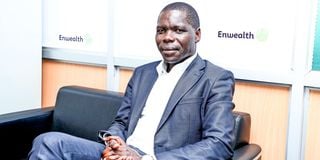
Enwealth Managing Director Simon Wafubwa during an interview at his office in Nairobi on September 18, 2023.
Photo credit: File | Nation Media Group
Lawyers also warn that sudden wealth often fuels disputes. The Kenya National Bureau of Statistics Economic Survey 2025 shows that the Judiciary handled over 431,600 cases in 2024, many involving succession issues that often turned contentious.
“Sudden wealth is not a curse but an opportunity. The curse manifests only through lack of planning and poor advice. With discipline, legal guidance, and strategic planning, it can secure prosperity for generations,” says Clinton Lumumba, an advocate of the High Court.
For winners like Mr Kamau, the real challenge may not be in collecting the money, but in keeping it — and turning a one-time windfall into lasting wealth.