Time flies with great content! Renew in to keep enjoying all our premium content.
Prime
Struggling State firms gobble up 39pc of Kenya’s external debt
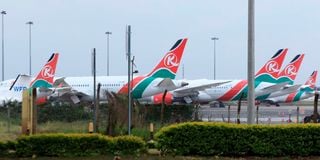
Kenya Airways planes at the Jomo Kenyatta International Airport (JKIA). According to AfDB report, the transport sector is the second-largest consumer of external loans, accounting for 21.8 percent, or Sh1.19 trillion, of Kenya’s foreign borrowing.
Struggling government-owned companies now account for more than a third of Kenya’s external loans as they increasingly rely on debt to sustain operations, a trend that is swelling public debt and repayment costs, and pushing the country closer to debt distress.
An analysis by the African Development Bank (AfDB) shows that of the Sh5.48 trillion owed to external lenders as of June, 38.5 percent – about Sh2.11 trillion – was borrowed to support underperforming State-owned enterprises (SOEs).
This makes SOEs key drivers of Kenya’s rising borrowing and debt service costs, deepening fiscal risks amid currency volatility and dwindling foreign exchange reserves.
“Budget support to prop up underperforming and poorly governed State-owned enterprises (SOEs) consumes the largest share of total external borrowing, at about 38.5 percent,” the AfDB said in a special report on Kenya’s debt.
The report was authored by AfDB country economist for Kenya Duncan Ouma and senior research economist Martin Nandelenga from the bank’s Macroeconomic Policy, Forecasting and Research Department.
According to the report, the transport sector is the second-largest consumer of external loans, accounting for 21.8 percent, or Sh1.19 trillion, of Kenya’s foreign borrowing. The energy sector follows at 9.4 percent (about Sh515 billion), while the remainder has been channelled to projects in water supply, health, agriculture, education, and other sectors.
“These factors have elevated Kenya’s debt service costs,” the AfDB warned. “According to the December 2024 debt sustainability assessment, Kenya’s overall and external public debts were assessed as sustainable but remain at high risk of debt distress.”
Kenya’s total public debt currently stands at Sh11.49 trillion, equivalent to 65.7 percent of GDP – well above the 55 percent threshold – heightening the risk of default.
Money owed by SOEs includes on-lent loans, guaranteed debt, and non-guaranteed debt contracted directly by public entities.
On-lent loans refer to funds borrowed by the government and subsequently extended to State agencies, while guaranteed debt comprises loans taken by SOEs but backed by government guarantees.
In the year to June 2024, these loans totalled Sh1.39 trillion, representing about 27 percent of total external debt. Although not all were borrowed externally, the government has yet to release updated figures for the year ended June 2025.
Based on the latest data from Treasury, on-lent loans surpassed the Sh1 trillion mark for the first time in the year to June 2024, reaching Sh1.2 trillion from Sh974 billion a year earlier.
Among the largest on-lent borrowers are Kenya Railways (Sh737.5 billion), Kenya Airways (Sh99.9 billion), Kenya Electricity Generating Company (KenGen) (Sh78.6 billion), and the Athi Water Works Development Agency (Sh55 billion).
In total, the government has borrowed on behalf of 54 State enterprises and agencies, while another 21 SOEs have taken non-guaranteed loans amounting to Sh78.2 billion. Although these are not backed by the State, they are still classified as part of public debt.
Additionally, the government has guaranteed loans worth Sh100.2 billion for Kenya Airways, KenGen, and the Kenya Ports Authority. Kenya Airways has already defaulted on its portion, forcing the Treasury to assume repayment.
The mounting debt burden of SOEs reflects the growing number of State corporations that are technically insolvent and dependent on budgetary bailouts to remain afloat, some of which have been loss-making for years.
Auditor-General Nancy Gathungu revealed that at least 22 State corporations and agencies were insolvent as of June 2024, requiring a combined Sh165.39 billion to stay operational.
Among the struggling entities are the Postal Corporation of Kenya (Posta), Kenya Electricity Transmission Company (Ketraco), Postbank, Consolidated Bank, Rivatex, and Sony Sugar, among others.
To reduce the heavy fiscal burden of loss-making SOEs, the International Monetary Fund (IMF) and the World Bank have urged Kenya to accelerate a large-scale privatisation programme, which is already underway.
More than 35 State-owned companies are slated for sale, including the Kenya Pipeline Company, which is expected to be listed on the Nairobi Securities Exchange by next year.