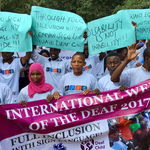
“Deaf people are at risk of marginalisation,” according to the Innovation To Inclusion Report by i2i in partnership with the Association For The Physically Disabled People of Kenya (APDKK). This is due to attitudinal, economic, environmental and institutional barriers which exclude them from socio - economic activities.
Employers are unwilling to hire them in customer facing roles for fear of negative impacts on the company’s image and revenue. Employers and staff members lack knowledge, and skills of communicating with deaf colleagues, which results in social isolation and workplace exclusion, and eventually poverty.
The UNDP Building an Inclusive Kenya, Disability Inclusion Status Report 2025 paints a gloomy picture: “Despite Kenya’s progress in disability inclusion through policies and affirmative actions, systemic socio-economic and cultural barriers continue to exclude persons with disabilities from full societal participation, leading to significant economic costs and under representation in the workforce amongst others.
"High poverty rates, persistent stigma, and fragmented coordination and support structures hinder persons with disabilities access to employment and essential services”.
Notably though, Kenya has made deliberate strides in recognising the rights of persons with disabilities, guided by the Constitution, the Persons with Disabilities Act (2003), and Vision 2030’s social pillar.
These frameworks commit the government to expanding access to education, social protection and gainful employment for all. Yet, for deaf Kenyans, inclusion in the workplace remains elusive.
Inclusive education is the first step towards equitable employment opportunities. Kenya has more than 30 special schools for the deaf and several integrated programmes, but gaps remain in teacher capacity, resources and transitions into higher education, and workforce.
The Karen Technical Training Institute for the Deaf in Nairobi is a notable example of how education can prepare deaf youth for employment. It offers both technical and professional courses, ranging from ICT and hospitality to entrepreneurship that give learners practical skills to compete in the job market.
Government policies stipulate that at least 5 percent of public service jobs should be reserved to persons with disabilities, which is not fully implemented.
Deaf people face barriers in job applications, interviews, and workplace communication. According to the UNDP Human Development Report, stigma, limited workplace adaptations, and inadequate enforcement of policy are key barriers.
The private sector has begun to respond more proactively. Safaricom, Equity Bank, and East African Breweries Ltd have set up diversity and inclusion frameworks that actively recruit and support employees with disabilities, including deaf staff.
These efforts prove that inclusive policies are strategic business decisions that enhance brand reputation and tap into a skilled, often overlooked workforce.
Meaningful inclusion means a Kenya where deaf children can study without barriers, transitto dignified work, access healthcare without fear of misunderstanding.
That vision is within reach as demonstrated by the initiatives taken by the government, corporates, and civil society provide deaf people with employment and skills to propel them to be financially self-reliant.
Employment cannot be seen in isolation, but also such areas as access to health. For deaf Kenyans, access to healthcare remains a challenge. Communication barriers mean that many avoid hospitals or risk misdiagnosis due to lack of interpreters.
A 2023 Kenya National Commission on Human Rights (KNCHR) report highlighted that deaf patients often rely on family members—compromising privacy and accuracy in diagnosis and care.
If critical services are not inclusive, then workplace inclusion is undermined. Employers can play a role by training staff in basic Kenya Sign Language (KSL), integrating interpreters in and adopting technology such as visual aids and digital sign-language tools.
On a positive note, The National Council for Persons with Disabilities (NCPWD) holds annual sign language training for public servants, in collaboration with the Kenya Institute of Special Education (KISE), which is also open to individuals and corporates.
Inclusion of deaf employees requires more than hiring targets. Practical steps include, adopting Kenyan Sign Language in training and orientation programmes of selected staff, e.g. customer fronting, Nurses, and other clinical staff, teachers, retail outlets, police service and the judiciary.
Providing interpreters or assistive devices like captioning devices, establishing mentorship and peer support, and partnering with institutions like the Karen Technical Training Institute for the Deaf etc. to create talents pipelines for deaf people.
Organisations should embed deaf disability inclusion in their strategy to create workplaces culture where deaf people can thrive.
Deaf Kenyans are already excelling in roles across ICT, music, creative art and crafts, technology, data entry and analysis, research, and sports.
With the right support, their contribution can be improved in mainstream employment according to a paper by KIPPRA Special Paper No. 32/2022 - Enhancing Inclusivity by Empowering Persons with Disabilities ( Elda Onsomu etal).
For Kenya’s public and private sectors, the challenge is no longer whether to include deaf people, but it is how fast and how effectively this can be achieved.
There is a business case; companies that embrace diversity unlock innovation, strengthen customer trust, build resilient workplaces, fulfil SDG and vision 2030 goals.
The writer is a HR Strategist, Career & Leadership Coach
Unlock a world of exclusive content today!Unlock a world of exclusive content today!