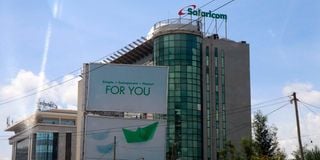
The State is planning to offload a 15 percent stake in Safaricom to South Africa’s Vodacom Group in a deal that will raise Sh244.5 billion for the exchequer to ease dependence on debt to fund its budget deficit, the Business Daily has learnt.
The amount comprises Sh204.3 billion for the six billion shares to be sold at a price of Sh34 each and an advance dividend of Sh40.2 billion.
The Sh204.3 billion is substantially higher than the Sh169.4 billion that the stake would have drawn from the market price of the Safaricom shares as of Wednesday.
The advance dividend to the National Treasury amounts to a hefty payout of Sh6.69 per share. Safaricom is expected to declare an interim dividend early next year as it continues with cash distributions to shareholders.
Sources familiar with the plan said that the sale of Safaricom shares is part of a wider plan by the government to dilute its shareholding in several enterprises to raise funds for short-term budget support.
Last month, Vodacom Group informed its shareholders that it would bid for extra Safaricom shares once the government resolved to dispose of a stake, with its group Chief Executive Officer, Shameel Joosub, saying that he expected the Kenyan government to reach out with an offer.
“In terms of increasing stakes, you know, we look at it in any market where our partners want to sell, we would consider it, and of course, we’d expect that they would talk to us, you know, as we’ve been partners for a very long time,” Mr Joosub said on November 10.
He made the remarks when he was asked if Vodacom was intent on raising its ownership in Safaricom.
The South African company, together with its parent Vodafone Group of the UK, holds a 40 percent stake in Safaricom, which is valued at Sh451.9 billion at the telco’s closing share price of Sh28.20 as of Wednesday.
The government's current 35 percent holding is valued at Sh395.4 billion. After the sale deal with Vodacom, the government would retain a 20 percent interest valued at Sh226 billion at the current price.
The amount set to be raised from the latest sale of Safaricom shares will surpass the Treasury's targeted amount of Sh150 billion from the privatisation of public enterprises in the current fiscal year.
Other shareholders in the telco hold a 25 percent stake equivalent to 10 billion shares, which was offloaded by the Treasury in a March 2008 initial public offer that raised Sh51.75 billion after being oversubscribed by 532 percent.
The Treasury is also planning to offload a 65 percent stake in Kenya Pipeline Company (KPC) through an IPO by March 2026 to raise about Sh100 billion.
This government decision to dilute its holdings in various enterprises follows the recent signing into law of the Privatisation Act, 2025, that came into effect on October 21, 2025.
Section 74 of the Act provides that the national government may sell or dispose of part or all its shares in a government-linked corporation with the approval of the Cabinet after a recommendation from the National Treasury.
Such a sale would, however, require ratification by the National Assembly. In the case of KPC, the Assembly gave its nod for the sale of the 65 percent stake on October 1.
The share sales in firms like Safaricom and KPC, if successful, would ease the Treasury's headache of funding a Sh901 billion budget deficit for the 2025/2026 fiscal year, which is set to be financed through domestic borrowing of Sh613.5 billion and external borrowing of Sh287.4 billion.
The deficit is likely to be revised upwards in the next supplementary budgets due to lagging ordinary revenue collection that was Sh90 billion below the target of Sh663.5 billion in the first three months of the fiscal year (July to September).
The disposal of a significant stake in Safaricom would ordinarily see a scramble for the shares by investors, given the company's record of profitability and steady dividend payment over the years.
However, analysts have said that the government's deal with Vodacom is likely to be a negotiated transaction that will be implemented off-market. The purchase price of Sh34 per share is, however, a signal that the telco is still trading at a significant discount despite its major stock price gain over the past 12 months to close at Sh28.2.
The stock previously hit record highs of Sh44.6 in 2021 after Safaricom won its licence to enter Ethiopia.
Safaricom remains the region's most profitable firm, riding on the back of data and M-Pesa, which has seen the operator consistently pay dividends.
The company reported a 52.1 percent rise in its net profit to Sh42.7 billion for the half year to September 2025, helped by a smaller loss in Ethiopia and M-Pesa's double-digit growth.
Safaricom launched in Ethiopia in 2022 as the government opened up the tightly controlled economy to foreign competition and is hoping its presence in Africa's second-most populous country will power future growth.
Its net profit grew from Sh28.1 billion the previous year, and it expects to declare an interim dividend in February 2026. The firm paid a dividend of Sh1.20 per share in the full year ended March 2025, representing a windfall of Sh19.2 billion and Sh16.8 billion for Vodacom and the exchequer, respectively.
Since Safaricom's listing in 2008, the Treasury has drawn about Sh550 billion in dividends from the company, making it one of the most lucrative sources of investment income for the public purse.
The company has also paid the government a cumulative Sh1.57 trillion in duties, taxes, and fees since its inception, with the latest being a Sh90.51 billion remittance in the half year to September 2025.
Safaricom, Kenya’s leading mobile carrier with close to two-thirds of the country's subscribers, is valued at Sh1.13 trillion on the Nairobi Securities Exchange.