President William Ruto is banking on two sovereign funds to deliver Sh5 trillion worth of projects over the next 10 years, highlighting the government’s resolve to shift from funding infrastructure projects using debt.
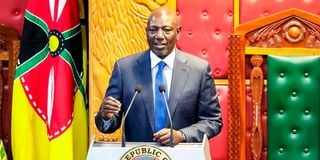
During an address to Parliament on Thursday, the President stated that funding for projects in the transport, energy, agriculture and education sectors, would be sourced from the Sovereign Wealth Fund (SWF) and the National Infrastructure Fund (NIF), rather than borrowing or relying on taxes.
The government has lined up projects valued at Sh5 trillion across the sectors, including the construction of hundreds of dams, tarmacking and dualling of roads, extension of the standard gauge railway (SGR) line from Naivasha to Malaba, growing electricity generation and boosting educational research.
The Ministry of Roads and Transport has already mapped out 2,500 highways for dualling and 28,000km of roads to be tarmacked in the next 10 years, with the launch of the dualling of 170km Rironi-Naivasha-Nakuru-Mau Summit Road scheduled for next week.
Other roads set for dualling include Muthaiga Kiambu-Ndumberi, Machakos Junction-Mariakani, Mau Summit-Kericho-Kisumu, Kisumu-Busia, Mau Summit-Eldoret-Malaba, Kericho-Kisii-Migori-Isebania, Nakuru-Nyahururu-Karatina and Nakuru-Nyahururu-Karatina, President Ruto said.
“We will also onboard private-public partnership (PPP) in the modernisation of Jomo Kenyatta International Airport (JKIA), Mombasa and Lamu ports, and sort out the challenges facing Kenya Airways by next year.
“This infrastructure drive will also include extending the SGR from Naivasha to Kisumu and eventually to Malaba beginning in January 2026,” Dr Ruto said.
The government has previously failed to undertake the expansion of JKIA through PPP, after a deal with Indian businessman Gautam Adani was cancelled, with plans to secure loans for the extension of the SGR to Malaba delayed.
He said the government wants to fund the multi-billion-dollar projects using the SWF and the NIF, highlighting the challenge to keep financing infrastructure development through borrowing and additional taxes.
The SWF will pool monies generated from Kenya’s natural resources, such as mining and petroleum products, and will have three components: a stabilisation unit, an infrastructure investment arm and a segment focused on savings.
On the other hand, the NIF will source capital from the sale of state-owned enterprises, private capital through PPPs and other domestic sources.
“Estimates indicate that achieving these four priorities will require at least Sh5 trillion. How shall we finance these transformative projects, and do so sustainably? The answer lies in two key financing vehicles: the NIF and the SWF,” the President said.
President Ruto's third state of the nation address
Other than infrastructure projects in the transport sector, the government has a plan to deliver 50 mega dams and more than 200 medium and small dams, whose funding will come from the two funds.
The government plans to add at least 2.5 million acres of land under irrigation in a span of five to seven years, with targeted dams including the High Grand Falls and Arror, which had previously been halted.
“The Ministry of Water, Sanitation and Irrigation, alongside all relevant agencies, has already mapped the precise locations of these dams. These projects span the breadth of our Republic; from High Grand Falls, a mega dam on river Daua in Mandera, Soin Koru in Kisumu, Narosura in Narok and Arror in Elgeyo-Marakwet,” President Ruto said.
Arror and High Grand Falls dams, which the government plans to fund using the sovereign funds, have previously faced compliance and legal challenges and their construction had been halted.
The government also plans to generate an additional 10,000 MW of electricity in the next seven years with the President noting that despite an installed capacity of 3,300 MW, “the intermittence of solar and wind means our firm capacity is only 2,300 MW — far below what the Kenya of tomorrow will require.”
In the Education sector, the government plans to actualise the national research fund by growing research funding from the current level of 0.8 percent to two percent of gross domestic product..
The current funding levels have left shortfalls of Sh180 billion, with the President indicating that he established a dedicated State Department for Science Research and Innovation, in order to scale up Science, Technology, Engineering and Mathematics courses in Kenya’s education system and help actualise the two percent research fund needed.
“... we should grow the fund to Sh1 trillion over the next 10 years. We will mobilise domestic public resources, private investment, venture capital and other private-sector financing to drive this effort,” he said.