The Kenya National Highways Authority (KeNHA) is set to revise the formula used to adjust prices for inflation on its contracted projects amid a worrying trend of billions of shillings in runaway costs that have burst budgets, leaving a trail of delayed and incomplete ventures.
The State agency has revealed that it plans to review the variation of price (VOP) formula for all its contracts to limit the rising cases of extreme changes to original project budgets.
VOP is an adjustment to a contract's initial price to account for changes in specific cost components such as labour, materials, and fuel, using a weighted formula that applies cost indices.
Also known as a price variation clause, it is primarily applied to long-term contracts to protect both parties involved in a project from economic fluctuations such as inflation.
“The variation of price adjustment is expected to shield the parties to the contract from changes in prices, and provide for a fair mechanism for risk sharing,” KeNHA said in a disclosure.
“However, in the recent past, the Authority has experienced unprecedented escalation of variation of prices (VOP) in ongoing development contracts, making projects expensive and giving rise to budgetary challenges,” it added.
The agency said that the sharp cost variations have negatively impacted project delivery amid budgeting uncertainties.
“Preliminary investigations point to wrong design of the Contract Price Adjustment (CPA), unbalanced weightings, changes in applicable indices management, wrong application of the formulae, and poor documentation at the project level, amongst others,” KeNHA said.
A recent Business Daily analysis of Treasury and Transport ministry data, for example, showed that a group of 26 infrastructure projects primarily earmarked for implementation by KeNHA and the Kenya Urban Roads Authority overshot an initial budget of Sh682.67 billion to Sh703.39 billion, representing a jump of Sh21 billion and providing a glimpse of the cost overrun problem.
Projects audit
As part of the shake-up of the VOP formula, KeNHA has lined up an audit of a sample of seven ongoing projects to ascertain the ideal limits of adjustments to the contract costs.
The audit will cover the Kapchorwa-Suam-Kitale and Eldoret town bypass roads project, Kenol-Sagana-Marua highway improvement project, Mombasa-Mariakani highway project, the Sirari corridor accessibility and road safety improvement project, Mombasa-Mtwapa-Kilifi road project, the Horn of Africa Isiolo-Mandera Corridor El Wak-Rhamu road upgrading project, and the Lesseru-Kitale and Morpus-Lokichar road upgrading project.
The audit would also cover at least two programmes (one ongoing and one completed) financed by the Government of Kenya, Middle East banks, KFW, World Bank, Exim Bank, European Union, JICA and Trademark East Africa.
KeNHA said that the pricing audit will prioritise the Kenol-Sagana-Marua and the Mombasa-Mariakani projects, both of which have reported increases in development costs.
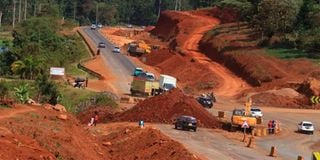
For example, the development cost of the Kenol-Sagana-Marua project increased by Sh3 billion amid budget cuts by the Treasury, which delayed compensation of landowners on the project corridor.
The State signed two contracts for the dualisation of the Kenol-Sagana-Marua road for Sh14.6 billion in 2020. Dualling of the 48km Kenol-Sagana section was meant to cost Sh8.49 billion, with the contractor projected to work for three years from October 2020. The dualling of the Sagana-Marua road was projected to cost Sh6.1 billion with a three-year construction period from October 2020.
An audit report published in March 2025 by the Auditor-General Nancy Gathungu, however, revealed that the cost of dualling the 36-kilometre Sagana-Marua road section had shot up by 49.6 percent in the year to June 2024, a shift blamed on costs that were not captured in the feasibility study, and land acquisition along crucial junctions.
“However, there was a revised contract completion date to July 10, 2025. Further, the original contract sum totalled Sh6,115,038,571, including contingencies. This was revised to a total of Sh9,146,922,301, including contingencies,” the audit notes in reference to the Sagana-Marua road section.
A report on the Kenol-Sagana-Marua project in September 2024 indicated that the venture’s feasibility study had failed to consider the cost of relocating community pipelines and some ICT equipment.
Road network
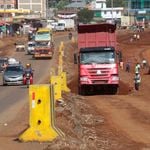
The cost of constructing and maintaining roads in the country has increased overall due to higher fuel and key road construction material prices, including tar and bitumen.
A latest projection by the Kenya Roads Board (KRB) showed that the average cost of periodic road maintenance by KeNHA was expected to increase from Sh3.94 million per kilometre, up to Sh6.06 million in 2023/24.
The latest inventory by KRB shows that Kenya has a total of 239,122 kilometres of road network (both national trunk roads (NTR) and county roads).
The KRB register showed that the country has 57,030km of NTR and 182,092km of county roads, marking a 48 percent jump over eight years when the network stood at 161,451 kilometres.
The increased road network means bigger budgetary pressure on the State, even as an inventory and condition survey conducted in 2023 showed that 30 percent of the network is in a poor state and is most likely to get worse if not revamped. A further 46 percent of the roads were classified as being under fair condition, meaning that they required revamping.