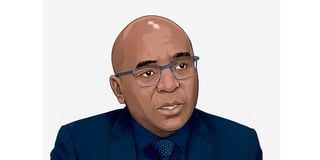
From the 30th floor of Times Tower, Humphrey Wattanga looks out over Nairobi’s skyline with a quiet confidence. For years, the Kenya Revenue Authority (KRA) has carried a reputation of being feared, loathed, and sometimes distrusted by its very clients—the taxpayers.
Indeed, just over a month after taking office, President William Ruto said: “Tax administration has traditionally been a harsh, repressive, menacing affair”.
Mr Wattanga, the Commissioner-General of the KRA whom the Ruto administration picked to transform Kenya’s taxman, says he is determined to turn that image on its head.
“We want to make compliance simple,” he told the Business Daily in a rare interview that lasted 23 minutes before dashing to a board meeting next door. “Our strategy is about voluntary and cooperative compliance. We aim to pre-populate tax returns, for instance,” he added, underscoring the KRA strategy under Ninth Corporate Plan.
The strategy aims to further cut bureaucracy at Times Tower, reduce paperwork, and let taxpayers focus on business by lessening the burden of manual processes when filing tax returns and paying taxes.
It is a radical promise from a man who rarely grants media interviews and speaks little in public. Mr Wattanga, who took the reins at the KRA in August 2023, has been described by insiders as a low-profile technocrat with a sharp mind, a keen eye for detail and an appetite for quiet but sweeping reforms.
Now, as KRA marks its 30th anniversary this month, he is laying bare his vision: to remake the tax authority into an agile, innovative and customer-centric institution, powered by technology and trust.
Mr Wattanga’s story begins far from Times Tower. An alumnus of the Alliance High School, he scored straight As in KCSE, earning a place at Harvard University, where he studied Biochemical Sciences before completing an MBA at the prestigious Wharton School of the University of Pennsylvania.
He built a career in finance, where he operated in the rarefied, discreet world of investment management, most recently working as managing director at Meghraj Capital. Before that, he had a stint in public service as commissioner and vice chair of the Commission on Revenue Allocation for a constitutional six-year non-renewable term.
However, running KRA is by far his toughest assignment yet.
As Kenya struggles to grow tax revenues to match its ballooning expenditure, Mr Wattanga’s approach is quietly radical. Instead of harsh crackdowns of recent years, he is betting on simplification, technology, and a culture shift.
“The whole premise here is to foster voluntary or cooperative compliance,” he said.
“We want to make KRA accessible within the environment of taxpayers, we are listening to their pain points, and we believe that compliance can actually be simple.”
It is a big gamble for a man who thrives in quiet, methodical spaces. But as he oversees the 30th anniversary of KRA, Mr Wattanga insists that trust, technology and transparency will be the tools that redefine the institution’s future.
“We are listening,” he said, pausing for emphasis. “And we are responding.”
At the heart of Mr Wattanga’s reform agenda is technology. He has overseen the creation of two new departments — Business Strategy and Enterprise Modernisation — to drive a digital-first transformation.
“We have been automated for much of the 30 years that KRA has existed, let’s say over the last 15 years. But those automated solutions have not been simple, especially for SMEs(small-and medium-sized enterprises) and emerging businesses,” he explained.
“So going forward, now with these new departments, we are rolling out simplified solutions that harness technology.”
One of these solutions is GavaConnect, an enterprise API platform that allows developers to build tax tools that can plug directly into KRA systems such as the online income tax system, iTax, and Electronic Tax Invoice Management System (eTIMS).
Mr Wattanga says the goal is co-creation: allowing developers to work with the KRA to create applications that provide solutions for the unique needs of taxpayers when filing and paying taxes.
But stability and reliability of the core tax systems have been brought into question: the iTax collapsed on June 30 as businesses and individuals raced to beat the deadline for filing returns and paying taxes, while the Integrated Customs Management System was down for six days in November 2024.
Aware that the struggle of the systems, especially during the peak of tax payment and filing days, will jolt his ambitious digital journey, Mr Wattanga has embarked on upgrading the iTax and iCMS from the back-end.
He is working not only on modernising the decade-old infrastructure, but also moving the systems to the cloud for scalability to ensure uninterrupted availability.
Artificial intelligence (AI) is already part of the digital transformation strategy. KRA is piloting AI-enabled customs scanners that can read images of goods at the border more accurately and much faster than revenue officers.
A Data Analytics Centre is also being set up to turn the flood of tax data from integrated government and private firms’ systems into insights that can help both the authority and facilitate taxpayers.
“Our digital transformation is premised on emerging technologies — AI, machine learning, and analytics. We want to leverage these capacities to make KRA truly world-class,” said Mr Wattanga.
For Kenyans whose sole source of income is employment, Mr Wattanga’s promise is simplification. “We want to get to a point where if you are purely an employed person or a nil filer, you don’t even have to file your returns,” he said. “We will pre-populate your return and present it to you. You just validate, and it’s done.”
He also wants to cut the pain for small traders, who often struggle with complex tax systems. “We are on eCitizen, and most of our SME taxpayers come through there because it is simple,” he explained. “We want to roll out more of those simplified platforms while allowing the market to innovate solutions using our APIs.”
But Kenya’s taxpayers remain wary of the taxman’s reach, especially over fears that KRA might pry into personal financial data. Indeed, the taxman has made two unsuccessful attempts at removing sections of the taxation law which prevent the KRA from accessing certain data considered highly personal and those which touch on business secrets. Mr Wattanga is quick to allay those fears.
“We have no direct access to M-Pesa wallets, unless it is on a case-by-case basis where there is fraud or investigations,” he said firmly. “Our interest is only in the minimal data required for tax assessment and not all that information that was being spoken about. We are very keen on matters of data governance, data protection, and data minimisation.”
To him, this is not just a legal requirement, but a trust issue. “Our role is not to collect trade secrets,” he said. "The relevant laws are adequate enough to enable us get information which we require from any transaction space, including digital marketplace. So we acquire data that is only required for assessing tax and nothing beyond that."
Mr Wattanga is also keen to position KRA within a global network of tax authorities. Kenya is a member of the Organisation for Economic Co-operation and Development (OECD) and participates in the automatic exchange of information with other jurisdictions.
“We are closely aligned to what is being developed under the OECD’s Tax Administration 3.0 strategy, which is founded on digitisation,” he said. “We also work very closely with HMRC (His Majesty's Revenue and Customs) in the UK, and Scandinavian authorities in Sweden and Norway. We learn from the best, and our aim is not just to catch up but to leap ahead.”
One of the OECD principles he is particularly fond of is cooperative compliance — the idea that tax authorities should work with, not against, taxpayers.
“It provides for transparency, trust and cooperation between the taxman and taxpayers. That is what we are aiming for at KRA,” he said.