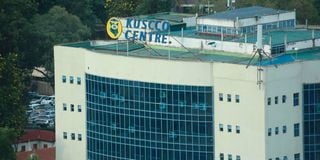
A dispute over ownership of a housing subsidiary linked to the Kenya Union of Savings and Credit Co-operatives (Kuscco) has prompted a fresh audit into the unit’s operations, amid concerns over a financial exposure of about Sh1.69 billion.
Kuscco, the umbrella organisation for saccos, says Kuscco Housing Co-operative Society (KHC) has operated for years as its subsidiary, where it holds a 70 percent stake. However, the apex body claims the unit’s directors have disputed Kuscco’s shareholding and attempted to assert their independence.
The dispute has prompted the intervention of the office of the Commissioner for Co-operative Development, with the commissioner, David Obonyo, ordering a review into the housing unit’s ownership structure and financial dealings.
A letter seen by this publication shows that Kuscco managing director Arnold Munene wrote to Mr Obonyo on August 26 this year, protesting the actions of the housing unit’s leadership, led by CEO Julius Odera. KHC has been attempting to rebrand and move out of Kuscco’s premises.
In the letter to Mr Obonyo, Mr Munene sought orders to stop officials of KHC from convening an annual general meeting. He also called for an investigation into Mr Odera and requested a review and audit of the company’s books of accounts, cautioning that losing control of KHC will lead to loss of money.
“We believe these actions are essential to protect member investments, uphold cooperative values, and maintain the reputation of the Union and the cooperative movement. We kindly ask for your immediate attention to this matter,” reads Mr Munene’s letter.
The commissioner’s intervention comes amid revelations of a Sh1.69 billion fraud linked to the housing unit, which formed part of a wider Sh13.3 billion loss uncovered at Kuscco following a forensic audit conducted by PricewaterhouseCoopers (PwC).
The PwC fraud in KHC was in the form of former senior Kuscco officials irregularly tapping loans in their name and that of their associates, defaulting on payment, and then falsifying the books of accounts to conceal the theft. The fraud in housing loans was concentrated in KHC and Kuscco Housing Fund (KHF) —a Kuscco department that was restructured to KHC in December 2019.
For instance, the audit revealed that 240 loans valued at Sh1.11 billion were issued in excess of the maximum allowable limit of five times members’ savings, with the officials of Kuscco, KHC, and KHF leading in irregular borrowing.
Mr Odera is among the few Kusco officials who remain in office, serving as CEO of KHC, despite a forensic audit linking him to several financial improprieties, including conflict of interest, borrowing beyond allowed limits, and defaulting on payment.
For instance, the PwC audit shows Mr Odera obtained a Sh10 million loan from KHF against savings of only Sh940,700, representing a multiplier of 10.6 times. He also took a top-up loan of Sh4.5 million against savings of Sh228,000, translating to a multiplier of 19.7 times —far exceeding the approved maximum of five times.
Mr Munene’s letter prompted Mr Obonyo’s office into action. He appointed assistant commissioner for Co-operative Development of Nairobi, Fondo Nzovu, and senior co-operative auditor of Nairobi, John Kariuki, to carry out investigations.
Mr Munene states that Kuscco has been the “primary financier and operational backbone” of KHC, and the unit continues to operate within Kuscco premises, yet some board members are claiming full ownership and control.
“Some KHC directors have initiated a legal challenge against Kuscco’s shareholding structure and its representation on the KHC board. This action is described as inconsistent and misleading, given that Kuscco has historically held a majority of seats on the KHC board,” said Mr Munene in the letter.
The investigations concluded last Wednesday though no formal findings have been released. KHC was formed in 2019 after Kuscco amended its bylaws, restructuring the Kuscco Housing Fund (KHF) from an internal department into a subsidiary.
Mr Munene said Kuscco had facilitated the transfer of Sh416 million in member savings from KHF to KHC even as 80 percent of KHF members transitioned into the new unit. He cautions that this could be lost if KHC breaks away.
The PwC audit revealed irregular loan approvals, diversion of rental income, and procurement anomalies. Kuscco argues that allowing the KHC team to continue carrying out affairs as though they are independent is an attempt to escape accountability.
“The findings provide a strong legal basis for an inquiry and potential legal action against the CEO and other involved parties, as they demonstrate a failure to protect the financial interests of the cooperative and its members,” said Mr Munene in the letter.
KHC shareholding was set at 70 percent for Kuscco and 30 percent for individual and corporate members, with a requirement that Kuscco retains at least 51 percent of ownership and board representation in all subsidiaries. This arrangement saw Kuscco nominate six of its directors, including the then managing director, George Ototo, to serve on the KHC board.
Mr Munene told Mr Obonyo that KHC has over the years “relied extensively” on the financial, operational, and infrastructural support of Kuscco, including the Sh113.57 million disbursed between 2020 and July 2024 to cover staff salaries and office consumables for the unit. In 2020 alone, Kuscco absorbed Sh6.03 million in administrative costs of KHC.
Individuals joining KHC pay a registration fee of Sh3,000 with minimum shares of Sh20,000 and are sustained with at least Sh3,000 monthly contributions. Corporations joining KHC pay Sh10,000 with minimum shares of Sh50,000 and minimum monthly contributions of Sh10,000.
KHF and KHC continued to operate even after the restructuring, complicating the web of financial transactions. Kuscco is currently auctioning houses in the hands of 684 individuals who have defaulted on a Sh1.7 billion loan issued under KHF.
Kuscco is keen to maintain control over all its units as it seeks to recover the billions of shillings lost over the years through a web of financial improprieties.
Kuscco targets to recover at least 70 percent of the Sh8.8 billion principal amount that Saccos had invested in the umbrella entity within the next three years. This is through loan recoveries, auctions of houses and land for those who defaulted on mortgages, and the sale of a stake in the insurance arm.