Kenyan investors injected nearly Sh100 billion into the Democratic Republic of Congo (DRC) in 2022, underscoring the surge of interest that accompanied the country’s entry into the East African Community (EAC) that year.
A new survey on foreign investments conducted by the Kenya National Bureau of Statistics (KNBS), the Central Bank of Kenya (CBK) and the Kenya Investment Authority (KenInvest) shows that the surge in money flows quickly cooled the following year, reflecting both the initial excitement and the risks that continue to shadow investment in the troubled Central African state.
Investment activity between Kenya and DRC had been minimal until then, with regional giants like Equity Bank and KCB Group among the few that had ventured into what many considered a risky market. That changed dramatically in 2022 when DRC entered the regional trade bloc.
Equity Bank had entered earlier, buying ProCredit Bank in 2015 before significantly expanding its presence in 2020 through the acquisition of Banque Commerciale du Congo (BCDC). By 2022, Equity had positioned itself as one of the largest foreign lenders in DRC.
Beyond banking, other sectors began to follow. BDO East Africa, an audit and advisory firm, announced its entry in 2022, signalling that professional services were also moving to support the wave of Kenyan manufacturers, traders and financiers pouring into the country.
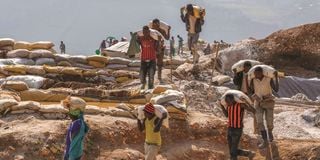
The mining sector accounts for half of DRC’s economy and drives its gross domestic product (GDP).
DRC is estimated to have $24 trillion worth of untapped resources - including cobalt, gold and copper.
The country is currently the world’s largest supplier of cobalt, which has defence and aerospace applications as well as being essential for batteries in electric vehicles - but most of this goes to China.
It also has significant lithium, tantalum and uranium deposits, which also have military uses.
In April 2022, a joint Kenya-DRC trade mission organised with support from Equity Bank saw 26 Kenyan companies commit investments worth Sh208 billion in DRC.
The list included Rentco Africa, Optiven Group, Greenlight Planet, Jumbo Foam, BIDCO, Geomaps and Nyanja Associates. The pledges cut across mining, energy, agribusiness, ICT and retail, reflecting DRC’s breadth of opportunity.
DRC formally joined the EAC in July 2022, bringing its more than 90 million people into the bloc. This offered Kenya—the only EAC country that does not share a border with DRC—new trade opportunities through the bloc’s common market protocol, which guarantees free movement of goods, services and people.
For Kenya, a country seeking to expand its exports and position itself as the region’s commercial hub, the new entrant was a good catch.
Investors, ranging from large corporations to small traders quickly flocked to Kinshasa, lured by the prospect of a vast, underdeveloped market.
But the honeymoon was short-lived. While flows of capital surged in 2022, they declined sharply in 2023 as conflict flared in eastern DRC.
The Rwanda-backed M23 rebel group escalated attacks in the mineral-rich region, dampening investor sentiment.
The survey records a reversal in 2023, with DRC becoming one of the top sources of inflows into Kenya.
“Within Africa, the highest inflows of foreign liabilities were from the Democratic Republic of Congo, South Africa and Mauritius, at Sh32.9 billion, Sh32.6 billion and Sh21.7 billion, respectively,” the survey states.
Part of the attraction of DRC is its extraordinary resource base. In 2022 alone, DRC produced cobalt worth Sh779 billion, accounting for 70 percent of global supply, according to the Massachusetts Institute of Technology’s Observatory of Economic Complexity.
Copper exports were even larger. Refined copper earned Sh2.12 trillion, while copper ore and raw copper added another Sh202 billion and Sh178 billion, respectively.
In total, mineral exports amounted to Sh3.7 trillion in 2022. Yet analysts argue this is only scratching the surface. The US International Trade Administration estimates that the DRC’s untapped mineral reserves are worth Sh3.1 quadrillion.
The mineral boom has attracted banks, including Kenyan lenders, keen to finance trade in commodities that dominate global supply chains. But it has also heightened risks, with much of the fighting in eastern DRC revolving around control of mineral-rich territory.
The Kenyan government has been supporting its citizens, encouraging local companies to expand into DRC as part of a wider push for regional integration.
Industrialists see potential in sectors ranging from construction materials to fast-moving consumer goods, while professional services firms aim to support this growth.
The sharp decline in outflows after 2022 underscored how fragile investor confidence remains, with the country still grappling with political instability, conflict and poor governance.