Kenya recorded an unusual spike in the value of gold exports in the three months ending June amid reports that the country is emerging as a transit hub for smuggled gold from other African countries.
The country exported 1,217.79 kilogrammes of gold to Dubai in that period, data collated by the Kenya National Bureau of Statistics show, earning Sh8.19 billion.
The second-quarter earnings were more than four times the country’s average annual gold earnings of Sh1.81 billion recorded in the decade to 2023, and nearly double the full-year export value for 2023, which stood at Sh4.70 billion.
Shipments to Dubai in the three months were double the average exports for the full year in 2022.
Authorities have linked the increased shipments to the sharp rally in global gold prices, as well as increased activity among artisanal miners who sell their harvest to brokers and local investors selling the precious metal to unlock value.
Harry Kimtai, the Principal Secretary for the State Department for Mining, attributed the unprecedented levels of gold earnings largely to ongoing formalisation of artisanal and small-scale mining (ASM) operations and the global rally in gold prices.
The government-led facilitation of artisanal miners has contributed to higher volumes of officially recorded exports, he said, while a jump in global gold prices by “more than 50 percent since January 2025” has prompted investors to sell their holdings.
“The jump in gold exports may be attributed to ongoing reforms in the mining sector in Kenya, coupled with the global price rally that has seen gold attain the highest price in history. The price rally has led most investors to liquidate their gold holdings to take advantage of the record prices,” Mr Kimtai told the Business Daily.
“We have continued to facilitate gold and other minerals extraction through formalising the artisanal mining sub-sector. The ongoing registration of ASM cooperatives has led to a significant increase in formal operations that have contributed to the rise in export volumes.”
A recent report by the Swiss development charity, SwissAid showed that Kenya was increasingly serving as a transit hub for smuggled gold from other African countries, including South Sudan and the Democratic Republic of Congo.
Illicit outflows from the country likely exceed the amount of declared gold exports by multiple times, according to the Bern-based organisation.
Most of the gold smuggled out of Kenya, the report said, is shipped to Dubai and declared for import there, with India and South Africa among the other destinations.
Kenya may also have become a conduit for gold from Sudan, where a civil war has raged since 2023.
A similar report by the group last year argued that revenue from such trade was fuelling conflict, financing criminal and terrorist networks, undermining democracy and facilitating money laundering.
The price of gold reached a record high of more than $4,000 an ounce as investors seek safe havens for their money amid concerns about global economic and political uncertainty.
Gold has seen its biggest rally since the 1970s, rising by around a third since April when US President Donald Trump announced tariffs, which have upset global trade.
The spike in Kenya’s earnings from gold exports coincided with a sharp rally in global gold prices this year. The international average price per ounce rose 12.1 percent between March and June to $3,369, up from $3,005 three months earlier, according to global commodity trackers.
The surge lifted the precious metal to the top of its export basket to the UAE, leapfrogging jet fuel re-exports, goat meat, tea, and cut flowers.
The growing Kenya’s gold export numbers will, however, reignite scrutiny over the country’s traditionally opaque trade in the precious metal.
The report by SwissAid cited discrepancies between Kenya’s official export data and gold import records from global trading partners.
It indicated that Kenya officially exported 672 kilogrammes of gold in 2023, for example, yet import records from the UAE showed 9.65 tonnes of gold declared as having originated from the country in the same year.
The mismatch between 2014 and 2023 added up to over 33.5 tonnes worth about $1.68 billion (Sh218 billion), according to the report.
“Almost all gold mined or imported into Kenya leaves the country, but only a fraction is recorded by official statistics,” the report said.
Citing unrecorded gold flows, SwissAid described Kenya as a critical transit hub for illicit metal from conflict zones in the Democratic Republic of Congo (DRC), South Sudan and parts of Ethiopia.
Responding to questions about the surge in gold export figures this year, Mr Kimtai said: “Kenya is a transit country for gold from neighbouring countries and there may be instances where the gold originating from our neighbours is declared as originating from Kenya and thus contributing to the numbers.”
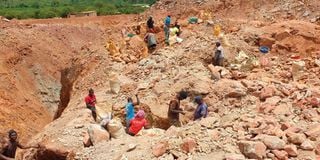
At the heart of the mismatch is the ASM sector, which accounts for more than 90 percent of Kenya’s gold output.
Concentrated in the counties of Migori, Kakamega, Siaya, Narok and Vihiga, the ASM industry employs an estimated 500,000 miners and supports the livelihood of about two million people indirectly.
A 2019 baseline survey estimated annual ASM production at 6.9 tonnes, dwarfing the roughly 410 kilogrammes produced by Kenya’s two licensed industrial mines — Karebe Gold Mining Ltd and Kilimapesa Gold PTY Ltd.
“Most of the ASM (artisanal small-scale mining) gold is never recorded in government books because it is either traded by unlicensed dealers internally or smuggled to neighbouring countries through the porous borders. As such no data on gold from ASMs as of now,” one expert told SwissAid.
The organisation noted that legislation was introduced in 2023 to formalise small-scale mining and reduce the illegal gold trade, but it has not yet become law.
Weak enforcement, lack of licensing and porous borders have allowed unregistered traders to dominate the gold supply chain in Kenya.
From mining sites in Western Kenya, gold is often transported to Eastleigh in Nairobi, where middlemen and refineries operate in the shadows, according to the report. From there, unrecorded gold is smuggled out through Jomo Kenyatta International Airport (JKIA), sometimes disguised as legitimate cargo.
The Global Initiative Against Transnational Organized Crime (GI-TOC) estimated in a 2023 report that between 100 and 200 kilogrammes of Congolese gold enters Kenya every month, translating to about 2.4 tonnes a year, valued at $140 million (Sh18.20 billion). The traders use Nairobi and Mombasa as re-export points to Dubai.
This explains why UAE import statistics consistently show higher volumes than Kenya’s declared exports. In 2021, for example, the UAE recorded $185 million more in gold imports from Kenya than what Kenya reported as exports.
The proliferation of private gold refineries has further blurred the lines between legitimate and illicit trade.
Companies such as Afrik Gold Testers, Gulf Refinery, and Emirates Refinery Ltd have sprung up in Nairobi and western Kenya and are reportedly backed by Dubai-based investors.