Time flies with great content! Renew in to keep enjoying all our premium content.
Prime
Kenya’s power imports hit a record in August on supply from Uganda
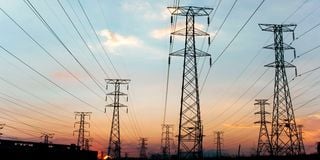
High voltage electricty transmission lines. Kenya Power Managing Director Joseph Siror recently said the reliance on imported electricity is increasingly leaving the country exposed.
Electricity imports hit a record high of 150.45 million kilowatt-hours (kWh) in August 2025, bringing to the fore Kenya’s deepening reliance on neighbouring countries to avert power rationing.
The latest official data shows that Kenya’s overall electricity imports rose five percent from 142.36 million kWh a month earlier, driven by increased supply from Uganda.
Kenya nearly doubled imports from Uganda in August, supplying 32.5 million kWh compared to 18.95 million kWh a month earlier, as imports from Ethiopia dipped in the same period.
Kenya recently completed another transmission line to Uganda, enabling it to buy more electricity from the neighbouring country. The new connectivity to Uganda ensures an enhanced supply of electricity to western Kenya.
Kenya has, in the last few years, significantly relied on Ethiopia and Uganda to bolster supplies and avert possible load shedding amid a rising demand and a freeze on new power purchase agreements.
Electricity demand hit a new peak of 2,363.41 megawatts in August this year, pointing to the surge in demand which has left Kenya staring at possible forced rationing in the absence of supplies from Ethiopia and Uganda.
Kenya Power Managing Director Joseph Siror recently said the reliance on imported electricity is increasingly leaving the country exposed.
“It is a major concern, and this is not premised on the thinking that they will be unable to support us. Rather, my concern is that this is hydropower from these countries and, in a situation where there is a serious drought, it may put them in a position where they might be unable to meet this obligation,” Dr Siror said two weeks ago.
Increased connections and the use of electricity by homes and industries are behind the growing demand.
The country imported 117.77 million kWh from Ethiopia in August this year, compared to 122.08 million kWh the previous month.
The record-high imports in August came in a month when local generation marginally dipped one percent to 1.146 billion kWh.
Generation from Kenya’s dams and wind power plants dipped in August, triggering the overall fall in the local electricity production.
Hydropower production in August was 296.01 million kWh from 320.73 million kWh the previous month, while output from the wind plants fell to 154.99 million kWh compared to 165.51 million kWh in the same period.
Hydropower is the second biggest source of power in the national grid, accounting for 23.7 percent in the eight months to August, ahead of wind and imports at 12.7 percent and 10.9 percent, respectively.
Geothermal, which is mainly supplied by the State-owned Kenya Electricity Generating Company, is still the dominant source of power in the country and had a share of 39.7 percent in the eight months to August.
Kenya has a 25-year power import deal with Ethiopia, where the country takes a maximum of 200 megawatts in the first three years, but this will double from December 2026.
Kenya also has power exchange deals with Uganda and Tanzania, where the country that imports more in a given period pays the other.