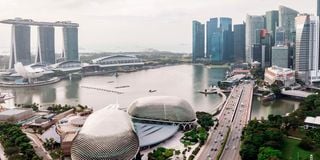
On November 20, 2025, President William Ruto presented a grand vision to transform Kenya from "third world to first world."
While the aspiration for prosperity is commendable, continued mentioning of the Singapore model as the only benchmark without assimilating her core elements and the use of the outdated "first-third world" framework are fundamentally misguided.
Kenya needs an alternative route to prosperity - one built on foundational values and tailored to its unique context, rather than a flawed foreign blueprint.
The President's use of "third world" terminology is a demonstration of neocolonialism of the mind and must be clarified. The terms "First World," "Second World," and "Third World" originated during the Cold War.
‘First World’ referred to the US and its capitalist, democratic allies. ‘Second World’ was the Soviet Union and its communist allies. ‘Third World’, on the other hand, referred to nations non-aligned with either the ‘First’ or ‘Second’ world blocs.
Clearly, therefore, Kenya was labeled "third world" simply for remaining non-aligned.
Even more clear is that these terms were tools of geopolitical categorisation, not economic destiny. However, they have now been used in a derogatory and simplistic way, perpetuating a colonial-era narrative that success requires abandoning one's own path for a Western-defined standard of "modernisation."
For a leader to copy this framework today is a regrettable step backward, unless the President wants Kenya to be taken over by the US.
The current administration champions a "big picture, big money" approach, frequently announcing ambitious, multi-trillion-shilling projects aimed at "joining the league of world class nations."
However, this focus on colossal budgets misses the tiny, yet essential, fundamentals that actually built Singapore and any thriving economy. These basics—discipline, integrity, honesty, meritocracy, and the courage to say NO to corruption—seem to have been misplaced along the way.
A values-based foundation can attract trillions, but trillions cannot buy values. Indeed, development is not magic; it is governance, credibility, and ethical leadership. It does not take rocket science to know that no country can develop if the custodians of its wealth have compromised ethical settings.
Fixation on an abstract "first-world" status ignores the immediate, fundamental needs of the Kenyan people: ensuring healthcare for residents in Kiambu, providing security and inclusion for citizens in marginalised areas like Tana River, ensuring timely capitation for children's education, and implementing viable funding models for universities and job market access for graduates.
The recent Gen Z movement, which mobilised to fight for a corruption-free Kenya, understood this instinctively, choosing to fight for the foundation of national dignity rather than chase a title we have not earned.
Singapore is a desirable destination but a wrong blueprint for Kenya. Blindly anchoring Kenya's narrative on Singapore’s success ignores two critical contextual differences. First, Singapore was positioned for a breakthrough even when its economic indicators seemed comparable to Kenya's in the early 1960s.
The British colonial power had invested significantly in the right education system and basic infrastructure for the vital trading port. In this developmental race, Kenya might have started the journey hours ahead, but Singapore was already fueling a chopper for take-off, while Kenya was navigating in a Land Cruiser.
Their fundamentals were simply ahead.
Second, the population disparity is critical. When Singapore became independent in 1963, its population was roughly two million. Today, it stands at about 4.8 million. Kenya's population in 1963 was approximately 8.6 million and is now over 56 million.
A development blueprint for a densely governed, ethnically distinct city-state of five million people is fundamentally not transferable to a massive, diverse republic of over 56 million. It would be more pragmatic for the President to advise the governor of Nairobi, whose city is closer in population size to Singapore, on urban delivery than to impose the city-state model on the entire republic.
Kenya is unique, but not special. We cannot be defined by any single country's success. Rather. prosperity must be sought through a Solomonic alternative path, one that understands that the political, social, and economic context of Kenya is too different for any single nation’s blueprint to suffice.
China, for instance, did not slavishly follow the European or American model. Instead, it copied shamelessly what worked elsewhere, discarding what failed: it adopted meritocracy from Japan and Germany, learned pragmatism from the Americans, and instilled a form of social ethics and discipline.
For Kenya, our focus must be on tapping into the deep-seated order and ethics seen in nations like Japan, where citizens respect law and order so that development becomes effortless. We must cherry-pick different, applicable elements from various successful models—especially those focusing on ethical governance, meritocracy, and rigorous public discipline.
The golden age for Kenya, and Africa, will be birthed when we focus not on an empty title like "first world," but on building an alternative route to prosperity founded on integrity and contextual realism.
Prof Ogola is Founder and Managing Partner at TrailBlazer Business Strategies Ltd