Time flies with great content! Renew in to keep enjoying all our premium content.
Prime
Kenya edges closer to trade deal with China after Trump tariffs
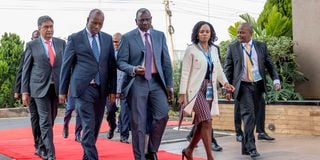
From front left: Investment, Trade and Industry CS Lee Kinyanjui, President William Ruto, and Kenya Private Sector Association (Kepsa) CEO Carol Kariuki arrive for the Presidential Roundtable with the Kenya Private Sector at Emara Ole-Sereni hotel, Nairobi County.
Kenya is inching closer to striking a landmark trade deal that will see agricultural exports enter China duty-free in what appears to be a direct response to the 10 percent tariff imposed by the United States this month.
President William Ruto said Kenya’s agricultural exports such as tea, avocado and coffee will in a “couple of months” access the world’s largest market by population at zero tariffs as part of the deal Nairobi struck with Beijing during his four-day State Visit in April.
Kenyan goods to China currently face tariffs as much as 10 percent because of the lower middle-income status of its economy unlike neighbours such as Uganda, Tanzania and Rwanda whose products are not subjected to taxation because they are low-income countries.
“They [Beijing] have agreed to a reciprocal arrangement between Kenya and China. They have agreed to remove all the tariffs on our tea, coffee, avocado and all other agricultural exports. That I think is a major breakthrough for us,” Dr Ruto told the 5th Presidential Roundtable with Private Sector players at a hotel in Nairobi.
“We are now finalising the bilateral instruments so that in the next couple of months, we should be able to take advantage of that huge market. It is partly why I have a bit of a problem with some of our friends, but it is what I must do for Kenya. It is in the best interest of Kenya.”
Dr Ruto termed the looming deal with China a “major breakthrough” that has got him into trouble with “some of our friends”.
This came a day after it emerged that a US senator had petitioned Congress to order investigations into the Ruto administration over relations with China, human rights violations and alleged involvement in the Sudan conflict.
The petition seeks a review of the strategic relationships between Washington and Nairobi on various sectors, including security where Kenya was in 2024 designated as a non-Nato ally of the US.
Cabinet Secretary for Investments, Trade and Industry Lee Kinyanjui said technical teams from Kenya and China have held two meetings in Nairobi since Dr Ruto’s State visit between April 22 and 26.
Mr Kinyanjui said some shrewd importers were buying goods from Kenya, diverting them to Kigali and rebranding them as Rwanda’s products to avoid the 10 percent tariff that Beijing charges Kenya, transactions he argues will stop when the proposed tariff deal is enforced.
“China has 1.4 billion people …and some of the provinces have 140 million people. If we were to plug into one percent of that market for our coffee or tea, it would completely change the lives of Kenyans,” Mr Kinyanjui said.
Kenya made accessing the populous Chinese market a priority under Integrated National Exports Development and Promotion Strategy, an export diversification plan unveiled in July 2018.
Nairobi in August 2018 posted five envoys to the Far East Asian region —including India, Malaysia and Singapore— with instructions to scout for market opportunities for Kenya’s largely raw agricultural exports in China.
Before the Covid-19 pandemic struck, Nairobi had been conducting aggressive trade promotion and marketing campaigns in China, primarily aimed at growing and expanding the market for Kenya’s tea and cut flowers.
Kenya Export Promotion and Branding Agency (Keproba) had, for instance, announced plans to set up a centre in Wuyi, a major tea-growing area in Fujian province, and Hunan, an agricultural province, to market Kenya’s goods.
China remains the largest source of imports with goods worth Sh576.14 billion shipped into Kenya last year, including railway wagons and vans, mobile phones as well as iron and steel products.
The trade balance is, however, heavily skewed in favour the East Asian economic powerhouse. Kenya’s exports closed 2024 at a measly Sh26.32 billion made up largely of titanium ores and concentrates, copper waste and scrap as well as tea.
“Some of our friends are complaining that we are doing so much trade with China. Honestly, when I sat with President Xi [Jinping of China], I had a very candid conversation and I told him that Kenya is importing Sh600 billion of products from China yet we are only exporting five percent [of goods],” Dr Ruto said on Wednesday.
“That trade imbalance is serious, and that is the reason they have opened up their markets for our agricultural products. That is good for Kenya and that’s the right thing to do. You [Kenya’s private sector] gave me instructions to go and negotiate with that market.”
The announcement came in the wake of Washington enforcing the baseline 10 percent taxes on Kenyan exports as part of President Donald Trump’s reciprocal tariffs from August 3 after the deadline for negotiations lapsed on August 2.
Dr Ruto, however, described the US as a “trading partner that we value and will continue to work with”.