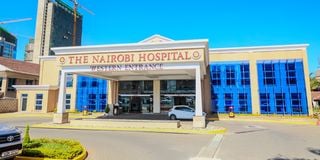
The Nairobi Hospital has hit patients with price increases of up to 61.3 percent on key services, including scans, ultrasounds and bed charges, triggering a standoff with insurers.
The insurance firms fear a surge in claims could force them to raise premiums or suspend coverage entirely.
The private hospital, which makes over Sh11 billion in revenue every year, adjusted the prices effective July 1, citing economic shifts that have led to “significant” supply chain disruptions that have increased the price of drugs and medicines, surgical supplies, laboratory and X-ray materials.
The price increases range from 2.07 percent to 61.3 percent or between Sh70 and Sh5,000 and affect services such as computed tomography (commonly referred to as a CT scan), magnetic resonance imaging (MRI), ultrasound and X-rays. There are also increments on daily charges for bed, high dependency unit (HDU) and intensive care unit (ICU).
In monetary terms, the largest increments are on pap smear and HPV test, abdomen CT scan and heart MRI where the cost has increased by Sh5,000 each to Sh16,500, Sh30,000 and Sh45,000 respectively. MRI for the chest has seen a Sh4,000 rise to Sh27,000 while ICU services will attract additional Sh3,250 to Sh42,250 daily.
Felix Osano, chief executive at The Nairobi Hospital, confirmed the new prices, saying they reflect the operating expenses such as increased cost of medical supplies and pharmaceuticals.
“The overall price adjustment implemented on some few service lines was an average of less than five percent, in contrast to an average cost increase of more than 11 percent. Importantly, the adjustment was selectively applied to specific service areas and was not a blanket review across all hospital services,” said Mr Osano in an emailed response to our queries.
While the hospital denied any standoff with insurers, letters seen by the Business Daily and interviews with others pointed to a dispute that saw the underwriters give the hospital 30 days, starting July 11, to stop charging the higher prices. They threatened to reject claims coming from the revised prices.
The standoff between the hospital and medical insurers now threatens to leave patients with huge out-of-pocket bills to foot.
In 2023 alone, the hospital admitted over 15,900 patients, attended to over 145,000 accidents and emergency cases, conducted 640,590 lab tests and issued 557,012 pharmacy prescriptions.
Mr Osano notified insurers of the price adjustments, saying they have been implemented on products and services where “cost fluctuations have been significant.”
Data from the Kenya National Bureau of Statistics (KNBS) shows that health inflation stood at 3.7 percent in June 2025, emerging as one of the top inflation drivers. Only food and non-alcoholic beverages (6.6 percent) and alcoholic beverages, tobacco and narcotics (5.2 percent) recorded faster annual price increases during the same period.
Insurers have written to The Nairobi Hospital protesting the increased charges and warning that they will reject claims coming from the new prices. They want the hospital to suspend the new prices, which they deem steep and claim the timing does not allow them to adjust premiums to cater for higher claims.
“We note with concern that the changes were effected without addressing the issues we raised ... Please be advised that the revised pricing will not be honoured until both parties reach a mutually agreeable resolution,” reads one of the letters from an insurer to the hospital.
Other insurers have taken a similar stand, asking the hospital to consult with them through their umbrella body, Association of Kenya Insurers.
Several underwriters who spoke to the Business Daily said that abrupt price reviews had the potential of cutting their margins or driving them into underwriting losses since they cannot revise contracts they have with customers until the end of the policy.
Medical policies typically run for 12 months. Medical insurers have posted underwriting losses over the past three years and they fear that price increments from health facilities such as The Nairobi Hospital will increase claims and deepen their underwriting losses unless they respond with increased premiums for customers.
Insurance Regulatory Authority (IRA) data shows medical insurers posted a Sh468.35 million underwriting loss in the year ended December 2024 compared with a Sh1.79 billion loss in the prior year. Medical claims paid rose by 20.2 percent to Sh44.62 billion from Sh37.11 billion during the review period.
Like insurers, The Nairobi Hospital has been see-sawing between profits and losses and upward revision of rates could help grow its revenue and earnings. Over the five years to 2023, the hospital has posted losses thrice but emerged from a Sh564.67 million loss in 2022 to a Sh190.72 million profit the following year.
Mr Osano said the hospital recognises the concerns raised by insurers but added that the goal is to strike a “sustainable balance between cost of care and patient access.”
He said the hospital would continue to engage insurers over the new prices.
Insurers have repeatedly accused private hospitals of inflating medical bills through exaggerated pricing, unnecessary tests, and the preference for costly branded drugs over generics.
However, hospitals have consistently pushed back, arguing that they cannot prioritise the cost-saving interests of insurers over the quality and urgency of care provided to patients.
Top five revenue earners for The Nairobi Hospital in 2023 were medicine and drugs (Sh3.67 billion), laboratory (Sh2.28 billion), in-patient bed fees (Sh1.58 billion), surgical (Sh964.38 million) and accidents and emergency (Sh844.42 million). The five accounted for 80.4 percent of the Sh11.6 billion the hospital booked as revenue in the review period.
In the hospital’s price reviews, prices for CT scans for the head and extremities and MRI for abdomen and angiography have each increased by Sh3,000 to Sh23,000, Sh28,000 and Sh35,000 respectively. That of high-sensitive troponin has risen by 41.7 percent or Sh2,500 to Sh8,500.
Services that have seen a Sh2,000 rise are neck CT scan, MRIs for either brain, neck, extremities or spine. The services will now be charged at between Sh23,000 and Sh27,000.
Daily charges for normal ensuites and South Wing suites (luxurious self-contained rooms) have also risen by Sh2,000 each to Sh26,000 and Sh30,000 respectively while charges for HDU have also gone up by a similar amount to Sh32,000.
The daily charges in the private rooms have risen by Sh1,000 to Sh18,000 while ward beds will attract an extra Sh500 to Sh11,500.
The price review has also added Sh1,500 on ultrasound for bilateral doppler to Sh12,500. Transvaginal and abdominal ultrasound have seen a Sh1,000 rise to Sh8,000 and Sh7,500 respectively while that of pelvis CT scan has gone up by a similar amount to Sh22,000.
Also reviewed upwards by Sh1,000 are charges of X-ray for abdomen and extremities to Sh4,000. Spine X-ray will be charged Sh500 more at Sh4,000.
Some 21 other services have seen price rises of between Sh70 and Sh670, with a steep rise being on haemoglobin test where price has jumped by 61.3 percent to Sh1,500 from Sh930. The price of blood culture, and ultrasound for prostate and pelvic has risen by Sh500 to Sh7,500.
The Nairobi Hospital started in 1954 as the European Hospital and grew overtime to a facility with a bed capacity of more than 400. It also operates six outpatient centres —Gigiri, Galleria, South C, Rosslyn Riviera, Capital Centre, and Kiambu— offering decentralized access to consultations, diagnostics and pharmacy services.