Time flies with great content! Renew in to keep enjoying all our premium content.
Indigenous voices exposing the world’s climate change hypocrisy
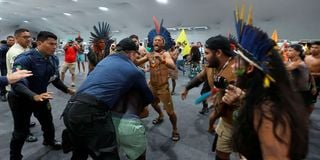
An Indigenous demonstrator is held by a security staff member as protesters force their way into the venue hosting the UN Climate Change Conference (COP30) in Belem, Brazil on November 11, 2025.
On November 14 at COP30 in Belem, Brazil, an extraordinary moment unfolded that exposed the brutal contradictions of global climate politics.
As delegates arrived for another day of glossy panels and diplomatic choreography, indigenous tribes of the Amazon blocked the main entrance to the conference venue.
This was not on the official agenda. Clad in traditional attire, bodies painted with ancestral symbols, carrying the spiritual weight of thousands of years of custodianship, they stood firmly and peacefully, forming a human barrier. Their message was clear: “Nothing about us, without us.”
What happened next revealed who truly bears the burden of the climate crisis and who pretends to solve it.
Corporate policymakers and government officials scrambled, bypassing the blocked entrance through exit doors, avoiding eye contact with the people whose lands they debate in panel rooms.
Brazilian military soldiers, UN security officers, armored trucks, and military patrols surrounded these peaceful protesters, as if the threat to COP was not the destruction of the Amazon, but the Indigenous communities defending it.
The people most affected by climate change, whose territories absorb carbon, shelter biodiversity, and stabilize global climate patterns, were met with rifles and shields.
Meanwhile, the biggest contributors to planetary destruction – those behind industrial agriculture, destructive mining, fossil fuels, and corporate land grabs – walked into air-conditioned halls to negotiate the future of those they left outside. That is the tragedy and hypocrisy of global climate politics.
For indigenous peoples, climate impacts are not theoretical. They are losing their land, forests, rivers, identity, and lives.
Their territories are invaded by loggers, ranchers, agribusiness giants, and multinational corporations, often backed by the very governments that claim climate leadership on global stages.
Indigenous peoples are not passive victims but frontline defenders. Their ecological knowledge, spiritual connection to land, and practices of living with nature offer some of the most grounded climate solutions humanity has ever known. Yet global systems continue to sideline, patronise, or militarise against them.
The Amazon is home to more than 400 Indigenous groups who have lived in harmony with nature for millennia. Studies consistently show that Indigenous territories have the lowest deforestation rates, the richest biodiversity, and the most intact ecosystems.
These communities sequester carbon not through billion-dollar technological promises but through cultural memory, custodianship, and land practices that work with nature, not against it.
Despite their unparalleled success in conserving ecosystems, they remain the most threatened people in the Amazon, facing violent displacement, land grabbing, illegal mining, assassinations of community leaders, and cultural erasure.
While states and corporations debate and water down climate commitments, civil society organisations (CSOs) carry the weight of real climate action. Their work is often invisible and underfunded, but fundamental and far more transformative than annual negotiation cycles.
Across the Amazon and the Global South, CSOs defend Indigenous territories from land grabs, support community-led forest management, document human rights abuses, and link local struggles to global justice movements. They translate global rhetoric into local awareness and refuse to allow the climate struggle to be reduced to carbon markets and profit calculations.
While official COP30 negotiations unfold in restricted halls dominated by state interests and corporate lobbying, the People's Summit, happening alongside COP30, offers something radically different: an open, accessible, community-led space where indigenous peoples are central leaders, not “invited participants”.
Here, discussions center on lived realities: the violence of extractivism, destruction of territories, criminalization of defenders, and alternatives rooted in Indigenous stewardship and grassroots organizing.
At the People's Summit, not in official negotiating rooms, the most honest conversations about climate justice occur, unfiltered by diplomacy, acknowledging that the climate fight is a fight for land, rights, culture, autonomy, and life itself.
The blockade was not simply a protest but a moment of reckoning. It reminded the world that the people who protect forests do so without millions in climate funding, without badges, titles, or applause.
When they defend their lands, they face criminalization, militarization, and violence. Meanwhile, those responsible for environmental destruction continue shaping climate policy in heavily guarded rooms.
This contradiction is why COP30 needed disruption. The Amazon is speaking, and its people are demanding to be heard. The world can no longer pretend not to hear them.
This moment demands humility, honesty, and radical transformation. Global institutions must stop sidelining Indigenous peoples and recognize them as leaders of climate solutions. Civil society's grassroots work must be elevated and respected. The world must finally confront the economic, political, and colonial systems that fuel the climate crisis.
If global climate summits are to mean anything, they must start by listening. The people standing outside COP30’s gates are not outsiders but guardians of the future we are all fighting for. The Amazon's indigenous people are not at COP30. They are COP30.
The writer is a Program Coordinator - Climate Change and Agroecology at the Alliance for Food Sovereignty in Africa (AFSA)