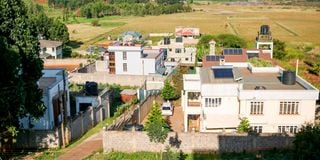
In most Nairobi satellite estates, progress has meant concrete, gates, and a quiet disappearance of neighbourly ties. But as new gated communities rise and glass windows gleam in the sun, Gikambura somehow seems unchanged. It feels like a village that remembers itself even as it grows.
Here, amid Kiambu’s quiet hills, neighbours still share flour and stories, farmers still deliver milk at dawn, and men and women still meet in chamas, bringing cash in hand rather than M-Pesa transfers. That enduring sense of community is Gikambura’s quiet charm in a county racing toward modernity.
“When I came here, it was just a forest,” recalls Johnson Mungai, who has lived here since 1958. “There were no roads, no houses, nothing. My father bought six acres for Sh200,000 an acre, people moved here to farm, not to invest.”
Back then, he says, families depended on dairy farming and muddy roads, but life was peaceful. “We sold milk to educate our children. The roads were bad, but we knew everyone by name,” he says.
Today, that same land, once dotted with coffee bushes, goes for close to Sh4 million per acre. From the Kikuyu–Limuru towns stretch, real estate billboards now compete for attention, promising “prime plots for sale” and “dream homes in a serene environment.”
Mr Mungai, now in his 70s and serving as a Nyumba Kumi elder, marvels at the transformation.
“Before 2010, you could walk from one end of the neighbourhood to another without seeing a house. Now there are homes everywhere ; big, beautiful ones. But it still feels like a village. People still know each other.”
That transformation in the last 15 years has made Gikambura one of Kiambu County’s fastest-rising residential suburbs, with property prices that rival established neighbourhoods closer to Nairobi city.
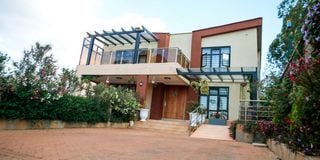
A house in Gikambura Kiambu county pictured on October 13, 2025.
Photo credit: Billy Ogada | Nation Media Group
Houses now go for between Sh13.5 million and Sh25 million for three to four-be rooms, with some high-end units listed at upwards of Sh35 million, depending on the finishes and proximity to tarmacked access roads. Monthly rents have also surged, with a four-bedroom house with a domestic servant quarters renting for as much as Sh200,000.
“Something about the air pulled me in.”
Among the newer arrivals in Gikambura is George Kamau, a business owner who bought his plot in 2018 for Sh2.1 million. “It felt like a gamble,” he says. “There were few shops, but something about the air and the view pulled me in.”
He smiles as he describes it. “The weather here is unique; warm and cold at the same time. Never too hot, but very chilly in June and July. From my compound, I can see all the way to Ngong Forest.”
Prices have risen sharply since then. “Now the same plot costs about Sh4.5 million, some even Sh5.5 million. The demand is high, especially from people working in Nairobi who want a quieter life.”
He built during the Covid-19 period, joining a construction wave that swept the area. “Every week you’d see a new fence, a new gate, another house starting,” he says. When he opened his school uniform shop, he realised Gikambura was more populous than it appeared.
“You only understand the population when you go inner,” he says.
What he loves most, however, isn’t the property value. “It still feels like a modern, silent village,” he says. “People have formed chamas, both men and women, and they still meet the traditional way; with money, flour, and cooking oil in hand. No M-Pesa. That’s the charm of this place.”
Fitness business boom
A short distance from his shop, coach Kevin Moruri runs Kevin Fitness 254 Gym, a business that tells a different story about Gikambura’s growth. “When I first came here, this road was quiet. You could go for a run without seeing many cars. Now by 6 pm, there’s real traffic,” he says.
His gym, which charges Sh5,500 per month, attracts mostly young homeowners aged 30 to 40. “These are family people who’ve settled here and made fitness part of their lifestyle,” he says.
Kevin Fit 254 gym owner Kevin Moruri speaks during an interview on October 13, 2025 in Gikambura Kiambu County.
Photo credit: Billy Ogada | Nation Media Group
He pays Sh50,000 in monthly rent, something unheard of in Gikambura a decade ago. “When I came here almost 10 years ago, a business like this would have struggled. But now people have the income to spend, and that shows the strength of this community’s growth.”
New ventures spring up
New commercial ventures are springing up fast: car washes, salons, modern supermarkets, and rental apartments where none existed before. “You’ll even find two-bedroom apartments going for Sh35,000,” he says.
The Southern Bypass has been pivotal, cutting travel time to Nairobi to under 40 minutes and drawing a new wave of professionals seeking space, fresh air, and relative affordability.
Local land agents say the demand isn’t speculative but residential, defined by real families building real homes. That explains the proliferation of hardware shops, construction trucks, and grocery stalls.
And yet, what sets Gikambura apart from other fast-growing suburbs is how it has held on to its sense of community. Even as bungalows and maisonettes rise, it still feels lived-in and traditional. The dairy farmers who still deliver milk in the morning, have managed to coexist with the new arrivals and their SUVs.