Time flies with great content! Renew in to keep enjoying all our premium content.
Prime
Generations & Memories: Artists reflect on Uhuru Park’s cultural and historical erasure
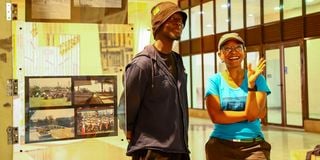
Artists Adam Yawe (left) and Ngwatilo Mawiyoo during an interview about their work during the Generations & Memories exhibition at Hazina Towers in Nairobi on October 1, 2025.
Photo credit: Wilfred Nyangaresi | Nation Media Group
The podium that stood at the centre of Uhuru Park for many years is no more. For the average Kenyan adult, it occupied a space of gathering for political, civil, cultural and religious purposes.
The promulgation of Kenya's new Constitution was celebrated here on August 27, 2012. Presidential inaugurations have been held here and numerous political and social rallies hosted at the Park.
For Adam Yawe, that podium was his initiation into Nairobi city on a skateboard. As a high school student, living on the West side of Nairobi, Adam discovered a community of skateboarders who met at Uhuru Park. The pavilion acted as the gathering point for the initial weekly sessions of the Skateboarding Society of Kenya from 2015-2010.
Between the two platforms was a gap. This gap offered the skateboarders a space to practice air tricks, getting off the ground landing onto the next platform.
Completely unregulated, as Adam recalls, the park allowed anyone to get in so there was often a mix of choirs rehearsing, dancers in choreography, preachers and food vendors occupying different corners.
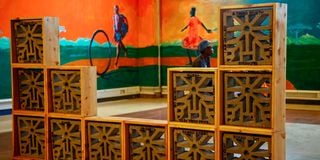
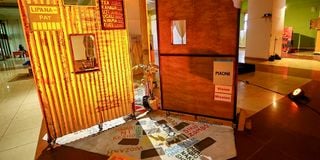
Art installation featuring a porous fence-inspired structure crafted from wood and ornamental concrete blocks during the Generations & Memories exhibition at Hazina Towers in Nairobi on October 1, 2025.
Photo credit: Wilfred Nyangaresi | Nation Media Group
In 2022, the platform was destroyed in the remaking of Uhuru Park and a profound gathering space was lost. In Adams' words, “the park that played a decisive role in my life and that of a distinct youth culture that met there was no longer accessible.”
Kenyan poet Ngwatilo Mawiyoo’s family initially lived close to Uhuru Park when she was a child. Her initial memories are filled with walks around the park, enjoying picnics and boat rides and a family favourite, taking photos. She recalls how green the grass was in the park, her favourite place to be on the weekends.
When the Trust for Indigenous Culture and Health (Ticah) came together to organise for its 2025 artist-led gatherings, or Rika residences, they settled on the theme of Generations and Memories. Through Rika, cultural practitioners of different artistic and cultural practices, ages and career levels would come together to explore a topic through cultural expression and community.
Curator, Eric Manya from Ticah, notes that this idea of turning to our previous memories and delving into history to shape the agency of the present day was novel, in that they had not done it before.
The Generations & Memories exhibition at Hazina Towers in Nairobi on October 1, 2025.
Photo credit: Wilfred Nyangaresi | Nation Media Group
The artist's journey involved confronting memories that were painful, unresolved and unreckoned with.
Decrease of public space
“We investigated the rapid decrease of public space, the bodies that lie buried beneath the soil, the political languages of obfuscation and erasure as well as different experiences of displacement on the journey to Rika25,” explained Eric.
The exhibition, which opened on September 18, at Hazina towers, was the culmination of months of collaboration. The three-week event featuring 20 artists and seven partners, only closed last evening with a performance by Just a Band.
Other artists who were part of Generations & Memories are Jim Chuchu and Collins Brian Odhiambo in a multi-channel video installation and performance.
On the older side would be Peter Kariuki, one of Nairobi’s longest serving photographers in conversation with Niklas Obermann who had a photo exhibition at one of the event sites.
Peterson Kamwathi and Martin Kigondu’s three wall installation questioned everyday encounters with power while Blaine’s Nostalgia mural focused on our complicated relationship with memory.
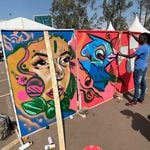
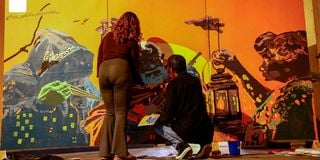
Nostalgia II, Blaine’s invitation to visitors to participate in creating a mural using a colour by number format, was a highlight of the exhibition. Beginning with a clean canvas, it invited guests to engage. By the second week it had all come together and what a beauty borne from a collaborative effort of outsiders.
The Generations & Memories exhibition at Hazina Towers in Nairobi on October 1, 2025.
Photo credit: Wilfred Nyangaresi | Nation Media Group
Paired together, Yawe and Mawiyoo realised Uhuru Park was their common denominator. Their different experiences of the space, decades apart, led them to question the meaning of the space it occupies and how this memory plays out against its intended use. Together, they came up with Porous Fences, banner and breezeblocks and more simply, Uhuru Park, archival images.
The idea of Porous Fences was taken from the question of access in public spaces. For Yawe and Ngwatiliyo, one of the first things that hit them was the massive ‘anti-climb’ fence built all around the park which seemed to say ‘stay out’.
Ngwatiliyo remembers that the walkways inside the park were demarcated by bougainvillea flowers. This has since changed. Now, instead of the green grass there’s several mounds of concrete in all forms around it.
The aerial images, taken from the Community side of the park, do not carry the same beauty with the prominent water feature in the middle. There’s something that’s been lost in all the concrete coming up to that park.
Echoes of kipande system
Previously, one simply walked into the park freely but now, every visitor has to show a form of identity card to be allowed access into the park, even though it is free. It hit a raw nerve for them; where had they interacted with this identity card or kipande system in a public space?
Nairobi had only existed with the colonialists keen on preserving the idea that some people are better than others. The pass system kept Africans in the highlands showing that not everyone could be in this space of rest, imagination and enjoyment, the city in the sun.
The question led them to think of Uhuru Park as a site within the city invariably turning to the history of Nairobi. To create a discussion around this, they invited Lydia Muthuma to lead a group of interested participants in framing the city and its some of its historic spaces as part of their installation.
Dr Muthuma, an art historian and lecturer at the Technical University of Kenya offers an aesthetic critique of spatial politics and visual culture.
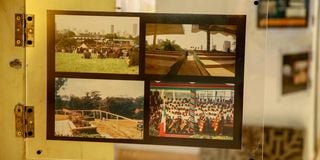
Archival images of Uhuru Park on display during the Generations & Memories exhibition at Hazina Towers in Nairobi on October 1, 2025.
Photo credit: Wilfred Nyangaresi | Nation Media Group
As the Rika25 curators explained, we live in a shadow of history, with legacies we carry and those we consciously refuse to remember. To understand our city and the buildings on its land would be to peel back to our colonial heritage, to another generation and its memories.
According to Dr Muthuma’s research, Nairobi’s original owners before 1899 were never acknowledged until the coming of the railway line. When the immigrant railways came, they pushed off the African owners with no known
compensation and sought to own the new swampy land, putting buildings to mark their ownership.
We had several stops beginning with Kipande House, built in 1913, then to Nairobi Gallery, the former Provincial Commissioners Office after independence. Through a tour of Kenyatta Avenue and the important historical sites around it, Dr Muthuma effortlessly went through changes of building and street names, the thinking behind many of these changes, the architectural thinking around many of the old buildings and the importance of memory.
How much of this information is deliberately shared is of concern. Does the city planning take into cognizance historical spaces, including ensuring the history of estates, names and places are accessible outside of having to dig into deep historical records like Dr Muthuma has done.
This is why this particular exhibition is weighty in how it engages the past to inform the present. Although artistic in nature, it requires a lot of mental engagement to find meaning behind many of the exhibited works.
Adam Yawe’s breeze blocks, which allow air to pass through them, were created to explain the idea of porous fences, which Uhuru Park previously had but are no more. The motifs on the breeze blocks are modelled from his memory of the now demolished spaces. His use of concrete takes from the urban as the city is literally made of this.
Ngwatiliyoo used her gift as an artist and poet turning the blocks into wordscapes of poems, stories and anecdotes from childhood like Rambo bambo, boom boom, a popular slogan used by Kenyan magician Johnny Rodriguez. The texts, borrowed from her own memory of the park, are painted onto the blocks inviting dialogue.The images were then printed on cloth and hung up to form another aspect of the exhibition.
These artists used older images of Uhuru Park borrowed from Mawiyoo’s father’s archives and Yawe’s photos of his time with the skateboarders. Today, the skateboarding community has moved to Sarit Centre’s rooftop where they practice their craft and build community around each other.
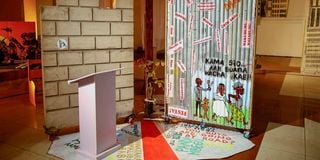
Guests interact with a piece of art during the Generations & Memories exhibition at Hazina Towers in Nairobi on October 1, 2025.
Photo credit: Wilfred Nyangaresi | Nation Media Group
We need the government to re-engage with the issue of cultural and historical erasure in this nation. Uhuru Park is only one of these monuments. Are there oral histories that must be maintained? Can it be multi-sensory?
Buildings whose previous historical names are obliterated by loud advertising slogans must be reclaimed to allow citizens to breathe. There need to be cultural ambassadors who already have the knowledge working to keep the memory of the city. Otherwise we risk a people with no care for where they have come from to inform the future.