Time flies with great content! Renew in to keep enjoying all our premium content.
Dhamana’s first deal signals new chapter for local-currency infrastructure finance in East Africa
Sponsored by Dhamana
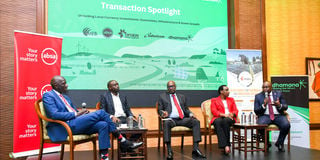
The Sh2.5 billion multi-party financing deal has brought together Ofgen (the project developer), Safaricom (the off-taker), Middle East Bank (the initial lender), Absa (the takeout financier) and Dhamana (the guarantor), enabling the entire structure to be conducted in local currency.
Photo credit: Dhamana
If you work in infrastructure, finance, or the wide grey zone between the two, you already know that big ambitions die quietly without the right partnerships.
In markets like ours, capital doesn’t move just because a project or an idea is brilliant, it moves because risk is understood, shared, mitigated, and sometimes nudged along by those brave (or stubborn) enough to insist that African markets can, and should, finance their own growth. Period.
That is the work Dhamana was built to do. And on November 18th, we proved it.
Dhamana announced its first guarantee-backed transaction: a KES 2.5 billion (~ USD 20 million) financing arrangement to solarise and hybridise Safaricom’s base transceiver stations across Kenya. This multi-party deal brought together Ofgen (the project developer), Safaricom (the off-taker), Middle East Bank (initial lender), Absa (takeout financier), and Dhamana as the guarantor enabling the entire structure to happen in local currency.
It’s one of the largest telecom modernisation and solar-hybridisation efforts in East Africa, and it isn’t just a clean-energy win, it’s proof of concept that local capital can support climate-resilient infrastructure when risk is intelligently mitigated and aligned.
In the words of our CEO Christopher Olobo, “Guarantees serve as an essential link between aspiration and investment… transforming a technical solution into a viable local-currency project that domestic capital providers can support confidently.”
He’s right. And this confidence shift is exactly why Dhamana exists.
So, why partnerships matter and why Dhamana is built on them? Infrastructure takes a village. A very technical, capital-heavy, risk-sensitive village. Partnerships are not mono, they are the operating system.
When people ask, “What’s the right time to pursue partnerships?” the real answer is, before you think you need them. Partnerships work best when they’re not a last-minute fix, but part of the design.
At Dhamana, partnerships are foundational. Our shareholders are themselves evidence of what strategic alignment looks like. PIDG’s project development arm – Africa (InfraCo) have helped set up InfraZamin in Pakistan, InfraCredit in Nigeria, and supported GuarantCo across multiple frontier markets, institutions that have unlocked billions for infrastructure and proven the viability of guarantee models in tough environments. Our establishment for the East African market was the logical next step.
CPF Group, a local county pension fund and one of Kenya’s strongest advocates for local-currency investment, has been instrumental in pushing the conversation on domestic capital mobilisation.
And that conversation matters. Pension funds in Kenya, Uganda, and Rwanda collectively hold roughly USD 30 billion. Yet less than 10% is allocated to infrastructure, and even that is often untapped. We like to talk about “mobilising domestic capital,” but let’s be honest, it’s hard to mobilise money that is allergic to risk. And pension funds are risk-averse for good reason, they hold you and I’s money, the life savings of millions.
But sometimes the biggest risk is the perception of risk. On the 18th November at Dhamana’s LC Investments event, CPF Group’s CEO Dr Hosea Kili accurately described it, our markets suffer from “risk inertia”, a reluctance to change our assumptions even when conditions evolve. Partnerships help break this inertia. Guarantees help break it faster.
As East Africa’s local-currency infrastructure guarantor, Dhamana sits precisely in that uncomfortable space between opportunity and hesitation. Our job is to create enough confidence for domestic capital to enter sectors it traditionally tiptoes around.
In this transaction, our guarantee de-risked a complex, multi-stage financing structure. By absorbing specific takeout and credit risks, Dhamana unlocked participation from Absa and Middle East Bank, both deploying local currency and both reducing exposure to FX volatility, which has quietly killed many well-meaning projects across the continent.
More importantly, this is replicable. As Absa’s Vice President Andrew Awilly put it, this model has “potential for replication across Africa” and replication is where transformation happens.
The African Development Bank’s participation in our establishment was, frankly, obvious. They’ve spent decades championing development finance, resource mobilisation, and the very mechanisms (like blended finance and partial guarantees) that we are now applying in East Africa.
Their approach has always been consistent: Reduce barriers, derisk markets, and crowd in capital.
With the AfDB, the conversation has never been about charity, it’s about scale. It’s about getting African institutions to trust African opportunities. And for a guarantor like Dhamana, that alignment is invaluable.
The hurdles are real. But so is the opportunity. East Africa has the capital, the appetite, and the ambition. Dhamana’s work sits directly in that gap, helping shift markets from “risk inertia” to informed confidence.
As Partnerships & Communications Officer, I see every day how partnerships reshape mandates. They enable, they contribute, they amplify. They move us from talking about potential to structuring it, financing it, and delivering it.
And if this first deal is any indication, East Africa’s infrastructure future will not be defined by hesitation...it will be defined by collaboration, boldness, and the insistence that local solutions deserve local capital.
Because when partnerships are intentional, aligned, and built on actual needs, they don’t just support a mandate...they move it forward.
To Keep Up to Date with Our Work, Check out OurLinkedIn