In 2021, Mwangi planted capsicum [bell pepper] as his first crop. He had the motivation, but the returns were disappointing. Four years later, he decided to switch to growing strawberries, which transformed his business.
“I wanted a crop that would thrive in a small space and offer higher returns. The returns from strawberries are far higher than those from capsicum,” he says.
This change was also motivated by the consistent market demand for strawberries, as well as their nutritional value.
When BD Life arrived at Mwangi's strawberry farm in Banana, Kiambu County, he had just finished transporting strawberries to market from an early morning harvest.
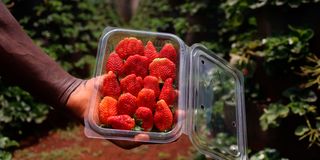
Inside the farm, his farm manager, Simon Nato, is busy packing the second batch of the day, grading the fruit carefully into punnets according to size and quality.
Mwangi tells BD Life that this is not a one-time activity at the farm. “We harvest three to four times a week. Strawberries don’t wait; they ripen quickly, and you must be ready for the market," he says with a smile.
On his one-eighth-acre farm, Mwangi has set up around 80 vertical gardens—tall structures stacked in tiers of six or seven, each holding 60 to 72 strawberry plants—which is triple the capacity of traditional ground planting.
“If you plant them in the ground, they take up too much space,” he explains. But with vertical farming, you maximise every inch. One-eighth of an acre can produce the same yield as an acre,” Mwangi explains.
These vertical gardens resemble staircases of greenery rising from the soil, creating the impression of farming upwards rather than outwards. This innovation enables him to produce as if he had acres of land despite his small plot.
“Here in Kiambu, we have limited land because many people now opt for apartments instead of farming. This leaves little space for agriculture, so those who want to farm must think differently,” adds Mwangi.
David Mwangi during an interview in his strawberry vertical farms in Banana, Kiambu County on September 18,2025
Photo credit: Evans Habil | Nation Media Group
The structures are made from dam liners, a durable material that lasts up to 10 years, unlike gunny bags, which deteriorate within months. Each vertical garden requires around 15 wheelbarrows of soil and four of manure.
“Manure is the garden's food,” Mwangi says.
At a cost of around Sh2,500 per garden, excluding drip irrigation, he believes the investment is relatively modest compared to the potential returns.
Mwangi started with 4,000 seedlings, and within three years, his farm had increased this number five-fold. Kenya boasts over 42 varieties of strawberries, but Mwangi chose the Chandler Red Giant F1 variety, which was imported from South Africa.
“This variety is export-grade. It has firm skin, stays fresh for three to four days after harvest, and can withstand handling,” he explains.
Its long shelf life also makes it popular with supermarkets and exporters, setting it apart from other varieties such as Portola, Cambridge, Pajaro, and Sanandria, which are better suited to making juice or for home use, but are less durable.
“Chandler, on the other hand, thrives in direct sunlight, requires no shade, and produces a consistent yield throughout the year,” notes Mwangi.
On average, 100 plants yield one kilogramme of strawberries per harvest. Each garden produces two 250-gram punnets every cycle, with harvesting taking place three times a week. With over 80 gardens, Mwangi supplies around 400 punnets per month.
At a farm-gate price of Sh150 per punnet, this amounts to roughly Sh60,000 a month. This price can increase to Sh400 per punnet when demand is extremely high.
However, not all fruit makes it to the premium market.
“Losses are part of the trade. Birds, pests and handling damage can reduce marketable yields by as much as 30 percent,” he acknowledges.
Mwangi grades his strawberries carefully. Grade 1 strawberries are large and uniform with up to 12 berries per punnet, intended for supermarkets. Grade 2 strawberries contain 13 to 18 berries per punnet and are also sold commercially. Grade 3 strawberries are smaller and less attractive and are often sold to juice vendors at lower prices.
He sells his strawberries directly from the farm to supermarkets, traders at Nairobi’s City Park market, hospitals, and walk-in customers. He emphasises freshness as a key selling point.
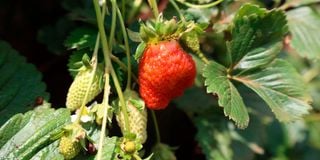
Strawberry fruit in David Mwangi's farm in Banana, Kiambu County on September 18,2025.
Photo credit: Evans Habil | Nation Media Group
A quick online search of various supermarkets showed that the price of a 250-gramme punnet at Naivas Supermarket is Sh299, a 200-gramme punnet at Carrefour costs Sh375, and the same weight at Greenspoon is Sh329. Despite this, he still struggles to meet demand.
“Demand is higher than supply. That’s why I’m encouraging more farmers to try growing strawberries. We provide training and seedlings to help them get started,” he says.
“Many people are not growing strawberries mainly due to a lack of knowledge. Some enter the field hoping for quick profits, but they often make mistakes that discourage them,” he adds.
The 44-year-old says he is not currently considering export markets. “First, I want to feed Kenyans,” he says.
According to the Agriculture and Food Authority (AFA), Kenya produced about 110 tonnes of strawberries last year, equivalent to approximately Sh21.9 million.
The process of growing strawberries begins with careful planting. Mwangi uses black cotton soil enriched with manure. After sowing, the seeds undergo a 14-day dormancy period before watering begins. From that point onwards, farmers must nourish the plants with organic foliage sprays and keep up with rigorous weeding.
By the second month, flowers appear, but Mwangi advises removing the flowers from the first and second rounds to give the plants time to develop strong roots and leaves.
“The size of the flower determines the size of the fruit. If you allow small flowers to develop early on, you’ll end up with small fruit,” he says.
After around 75 days, the plants are ready for production and will bear fruit for three years. After this period, they are replaced, although many plants produce offshoots that can be replanted, enabling stock multiplication over time.
As with most types of farming, a reliable water supply is essential for growing strawberries. At his farm, Mwangi uses a drip irrigation system connected to a 10,000-litre tank filled by a borehole.
“If you don’t have water, forget about growing strawberries. They don’t require much, but they need it consistently,” he says.
Like nearly all fruits, strawberries are vulnerable to pests such as spider mites, whiteflies and cutworms. However, Mwangi notes that, due to the frequency of strawberry harvests (three to four times a week), it is crucial to use safe chemicals.
“If you use the wrong chemicals, you’re feeding people poison,” he warns.
To combat pests, he uses rabbit urine as a foliar fertiliser, which fertilises the plants and repels insects.
“That's why our strawberries are so green,” he says. The farm also uses insect traps and netting to reduce fruit loss, although Mwangi admits that he still loses 30 out of every 100 punnets he harvests.
“It’s part of the challenge. That’s why we emphasise good management practices.”
For those interested in strawberry farming, Mwangi offers clear advice: “The first capital is information. People think strawberries are a quick way to make money, but without proper training, you’ll lose everything.”
A basic setup like his costs around Sh400,000 for an eighth of an acre, including gardens, manure, irrigation, and nets. He started on a smaller scale, though, initially investing around Sh150,000 in gardens and seedlings before gradually expanding.
Mwangi confirms that strawberry farming has drastically changed his life. Starting with a greenhouse experiment, he has built a thriving agribusiness that supports his family, pays their school fees, and creates opportunities for others through training and supplying seedlings.
He has employed four people to help with weeding, irrigation, harvesting, and distribution. In his community, he is commonly known not just as Mwangi, but as 'Mwangi wa Matunda', meaning 'Mwangi the fruit farmer', a name he earned through his passion for farming and which makes it easy to locate his farm. Despite his success, he acknowledges the challenges that come with farming.
“The biggest challenge is not the market, but a lack of information. Many people fail because they plant the wrong variety or don’t manage things properly. That’s why I focus on training. Even a small plot of land can transform your life,” he says.