This month, the Nairobi Contemporary Art Gallery will be hosting a one-of-a-kind historical exploit into a catalogue of colonialism across East Africa through a series of photographical works, in a show dubbed Looking into the Mad Eye of History Without Blinking.
The artwork is being shown by Ugandan artist Canon Griffin Rumanzi and is curated by Trevor Mukholi who describes it as a fusion of synergetic themes evolving around history, colonialism and democracy in the East African region with a heavier incline towards Uganda.
“The dichotomy of colonialism around East Africa is interconnected, Kenya was colonised through Uganda, they needed a place for the railway to pass which was the inception of marking and colonising Kenya,” he says.
Griffin began his artistic journey in 2011 as a commercial photographer, gaining experience as a TV videographer, studio photographer and part-time wedding photographer.
‘Pleading for Not Working for Chief’, a digital collage artwork by Canon Griffin Rumanzi, photographed on September 10, 2025, at the Nairobi Contemporary Art Institute.
Photo credit: Billy Ogada | Nation Media Group
He joined university to study agriculture, but later shifted his focus to advertising and design. Along the way, he partnered with Dutch photographer Andrea Stultiens to co-found a platform dedicated to exploring and documenting Uganda’s historical narrative.
Together, they sought to uncover and curate photographs of Uganda’s past, sourced both locally and internationally, creating a visual archive that traces the country's evolving history.
“We got them from private archives, families and institutions. This was a journey that my partner Andrea found frustrating. She had travelled to Uganda to uncover its history through photography, but all she found was Idi Amin photos,” he says.
“We wanted another path of unravelling that history that didn’t have a domineering figure. We wanted the complete package. Getting these pictures and the artwork involved a lot of persistency, connections and resource mobilisation.”
From an eye glance, some pictures like Buganda Punitive Menu bears the hallmark of an art piece that seeks to highlight social justice.
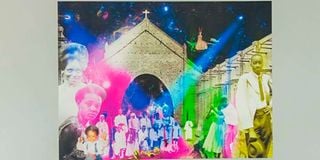
‘Unchurchly Congregations’, a digital collage artwork by Canon Griffin Rumanzi, photographed on September 10, 2025, at the Nairobi Contemporary Art Institute.
Photo credit: Billy Ogada | Nation Media Group
The photographs offer a stark reflection of deep-rooted injustices and impunities that persist despite the passage of time. Griffin doesn’t provide clear answers, nor does he take a definitive stance. Instead, he lets the images raise the questions.
“There is no person who can order execution now, this is in international law. Yet when you look at the narrative in my exhibition, it shows something different. During the Bush War in Uganda, the kind of justice system among the guerilla armies was the equivalent of a punitive menu, periods of absolute monarchs lacked accountability. It is almost like you are staring at absolute Sharia law led institutes, you would lose an arm or an eye for simply being a petty thief.”
Despite the sensitivity of his subject matter, Griffin doesn’t view his artistic expression as a risk to his security in Uganda.
Griffin’s exhibition explores themes of consciousness, justice, empathy and a move away from brutality. It reflects an artist’s analytical engagement with life, one that warns against adopting ideas without a deeper curiosity about the cultures they emerge from.
How the show will be received remains uncertain and like a floating island, Griffin seems to embrace this ambiguity from a position of thoughtful detachment.
His work is best examined through the eyes of a historian, a colonial-era missionary, or even a colonialist, as it frequently revisits these perspectives.
With the mindset and voice of a philosopher, Griffin’s approach is rooted in his long-standing love of reading, which continues to inform the intellectual depth of his art.
“When I am expressing the things that I express, I am barely antagonising anyone deliberately but at the same time I antagonise everybody including myself. I don’t think there is any direct risk likely to be brought out by this showcase because it would only be problematic if it is lifted off the walls of the gallery and directly plunged into a specific political contest currently happening,” he says.
For Canon Griffin, this is a scenario he wants to avoid completely because he believes his work transcends mere political activism.
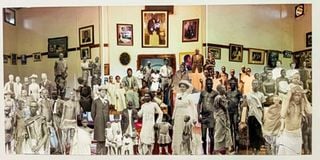
‘Traditional wear’, a digital collage artwork by Canon Griffin Rumanzi, photographed on September 10, 2025, at the Nairobi Contemporary Art Institute.
Photo credit: Billy Ogada | Nation Media Group
“I am aware of the folly that lies in the desire to have a change of signature or label or methodology of government outrightly. My biggest concern when creating is where my art and these pictures drive towards a reality, where we see each other being alive and aspiring towards enjoying our lives even 50 years from now and not just for Ugandans but for all people, everywhere.”
Looking into the Mad Eye of History Without Blinking is a sneak peak into both the lives of the vilified and the sanitised. It tends to look at power structures existing today that are as a result of the interaction between the indigenous communities and the British colonialists whereby religion became a mere side effect of the colonisation process, that came with its own negative perks.
For Griffin, it is the uncertainty of life and unplanned nature of existence which is the basis of how he puts up his installations.
The exhibition started on September 11 and runs till Sunday, November 2, 2025.
It is the unknown that he taps into to create works that stand on their own. The works present the conflict of individuality within the parameters of humanity. They represent the anguish of human inability to glide with the wind.
“My biggest goal in this exhibition would be the emphasis that everybody, as long as they are still thinking and looking and searching for answers, should be given space and the respect to begin building structures and ecosystems within which they can have a semblance of feeling that can lead to a better way of being here.”