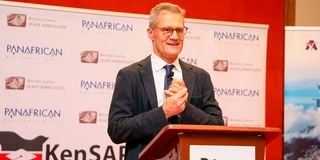
A Canadian investor has sold stock brokerage firm Kestrel Capital to a company backed by its management team, making it the latest deal in Kenya’s stockbroking business amid a market upturn.
Charles Field-Marsham will cede ownership to Theo Capital Holdings — which is owned by eight individuals including Kestrel CEO Francis Mwangi — for an undisclosed amount.
The deal ends Mr Field-Marsham’s 30-year association with Kestrel Capital, which focused on foreign and high-net-worth investors, as part of succession planning of his vast estate.
It comes months after Old Mutual Holdings Plc quietly sold its stockbrokerage subsidiary to a Kenyan fintech, shifting its focus to insurance and asset management business.
The deal also emerges in the middle of a bull run at the Nairobi Securities Exchange (NSE) that saw the net profits for stockbrokers and investment banks jump 156 percent to Sh1.1 billion in the six months to June.
Mr Mwangi will remain CEO of Kestrel as the stockbroker looks for a larger share of the retail clients and local institutional investors to reverse its falling fortunes.
The market intermediaries are coming from a lean decade in which their profits tumbled in the wake of a prolonged bear run, which depressed trading and brokers’ commissions.
Kestrel’s brokerage commissions dipped from Sh529 million in 2015 to Sh165 million last year, moving it from Kenya’s top broker to the 10th of 22 firms.
“The sale is part of succession planning on the founder’s end, and the sale to management has been an attractive prospect,” Mr Mwangi told the Business Daily in an interview on Monday.
“It has been 30 years on, and the founder of the business has not been involved on a day-to-day basis for the last 15 years.”
Seasoned investment banker Eric Ruenji is the chairman of Theo Capital Holdings.
“As the firm transitions to new ownership, I am proud to entrust Kestrel’s future to Francis Mwangi and the dynamic team at Theo Capital, led by Eric Ruenji,” Mr Field-Marsham said in a statement.
The unnamed six shareholders of Theo Capital Holdings will control between 3.5 percent and 19 percent stakes each.
They have been indirectly involved in the capital markets over the past two decades, Mr Mwangi said.
Mr Ruenji and Mr Mwangi have a 25 percent stake each in Theo Capital Holdings.
“This is more than an acquisition. It’s the start of Kestrel’s bold future. Our task is to preserve the foundation while adding accessibility and global connectivity innovation,” said Mr Ruenji.
Dry Associates ranked as the top brokerage ahead of Standard Investment Bank (SIB), Faida Investment Bank, Capital A Investment Bank, AIB-AXYS and NCBA in the six months to June.
Kestrel says its share of revenues from brokerage has eased from 85 percent over the past decade to 70 percent as corporate advisory gradually grows into a key business.
“Kestrel mainstay has been predominantly foreign institutional investors. Activity has shifted towards local institutional and retail investors and Kestrel has ceded its market share to others,” added Mr Mwangi.
Kestrel will be banking on the recent market recovery to rejuvenate its business on the back of its brand name and technology.
“The market size and opportunity are still immense. Kestrel is a well-known brand name. The best way to tap that opportunity would be to leverage the brand name,” Mr Mwangi said.
“It was clear that the markets can only remain low for so long. For investors who desire to earn a return, it would get to a point where there is a turn in the market and that’s what we have seen in the last one and a half years.”
The Nairobi bourse has seen a surge in trades this year, especially in the secondary bonds market, which resulted in brokerage commissions jumping by 49 percent to Sh1.46 billion, from Sh981 million in the first half of 2024.
Equity turnover at the bourse grew by 18 percent to Sh56 billion in the six months, while bond trades rose by 78 percent to Sh1.31 trillion, a record for half a year.
Should the market activity be sustained in the second half of the year, the stockbrokers and investment banks will be on track to rake in their highest commissions since 2015, when they netted Sh3.1 billion.
Stockbrokers normally charge a commission of 0.03 percent per bond trade and between 1.5 and 1.8 percent for equities, with the NSE and the Capital Markets Authority (CMA) also taking a cut from these commissions.
Dry Associates led the sector with brokerage commissions of Sh236.7 million, followed by Standard Investment Bank (SIB) at Sh154.9 million, and Faida Investment Bank at Sh151.1 million.
In terms of net profits, NCBA Investment Bank led with Sh278.2 million, thanks to earnings from fund management.