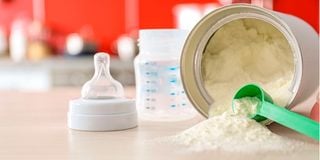
The average retail prices of baby formula products have dipped by up to 20 percent over the past year, aided by a stronger shilling against the dollar and competition among traders.
A spot-check by the Business Daily revealed that prices of popular baby formula brands have fallen by between 2 percent and 20 percent, equivalent to a reduction of around Sh150 to Sh300 for a 400-gramme tin of the product compared to a year ago.
For example, most retailers on Nairobi’s Biashara Street, which is popular for mass-market baby products, are now selling a 400-gramme tin of S26 Pro Gold at between Sh2,095 and Sh2,250, down from Sh2,300 a year ago.
A 900g tin of the PediaSure brand of baby formula, which sold for between Sh2,400 and Sh2,500 last year, is now available for between Sh1,995 and Sh2,295. The price of a 400g tin of baby formula brand known as Lactogen is now retailing at an average of Sh1,395, down from Sh1,500 a year ago, while Optilait, which retailed for about Sh1,300 a year ago, now sells at Sh1,195.
Another popular baby formula product known as “Cow & Gate” is now available at an average of Sh1,195, compared to between Sh1,495 and Sh1,595 last year. Some premium imported specialty formulas that previously cost between Sh3,300 and Sh3,500 are now priced at around Sh3,199.
Vendors attribute the drop in prices to the strong shilling against the dollar, which has remained stable at around Sh129 to one US dollar for the past year, with minimal fluctuations between Sh128.9 and Sh129.5 to one US dollar.
This stability has lowered import costs for retailers and suppliers, protecting them from global currency pressures.
“The selling prices started to decrease around November last year,” said Jonas Murioki, an attendant at a baby products shop on Biashara Street. He added that competition has also helped lower prices.
This decline in costs provides a relief for mothers who cannot exclusively breastfeed, including those with a low milk supply and working mothers who need to balance work with feeding their babies.
About two years ago, prices reportedly tripled from around Sh900 pre-Covid pandemic to approximately Sh3,000 amid severe shortages. The government linked the scarcity to new Health Ministry guidelines regarding baby formula, which, while aimed at promoting exclusive breastfeeding, appeared to have unintended market consequences.
Meanwhile, Kenya still lacks local production of baby formula and relies entirely on imports. According to Food and Agriculture Organization Statistics (FAOSTAT), shipments of infant food into Kenya rose from approximately 8.8 million kg in 2021 to 14.8 million kg in 2023, valued at $24.8 million (Sh3.2 billion).
Rwanda is the largest supplier by volume, followed by Mexico, with additional imports coming from Switzerland, the Netherlands, and other countries.
Although prices have eased, experts emphasise the significant health benefits of exclusive breastfeeding for the first six months of a baby's life.
“Exclusive breastfeeding is the cheapest and most effective way to keep babies alive in Kenya, but we are losing ground to substitutes,” said Grace Irimu, a paediatrician.
“The benefits of breastfeeding cannot be overstated. For babies, breast milk provides optimal nutrition for physical growth and brain development. It also offers immunity against infectious and chronic diseases,” the World Health Organization (WHO) added.
In Kenya, the early initiation of breastfeeding could potentially save 33 percent of newborns, while optimal breastfeeding could reduce under-five mortality by around 12 percent. Nevertheless, Kenya's neonatal mortality rate remains higher than that of Rwanda, Uganda, and Tanzania.
Kenya's legislative framework strongly promotes breastfeeding while regulating formula use. The Breast-Milk Substitutes (Regulation and Control) Act of 2012, enacted under the International Code of Marketing of Breast-Milk Substitutes, governs promotional practices.
An update in 2022 strengthened labelling requirements, mandating statements such as 'Breastfeeding is best' and prohibiting aggressive marketing strategies. The Breastfeeding Mothers Act of 2024 now requires workplaces to provide lactation rooms and flexible hours to support nursing mothers.
According to the WHO, Kenya has made significant progress in terms of exclusive breastfeeding rates, which increased from 13 percent in 2003 to 60 percent by 2022. This surpasses both the World Health Assembly’s target for 2025 and the global average of 48 percent in 2023.
However, these rates have plateaued since 2014. In order to reignite progress, Kenya is adopting the Baby-Friendly Hospital Initiative (BFHI) and providing health workers with training to improve their support of breastfeeding.