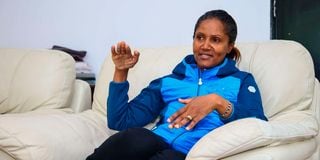
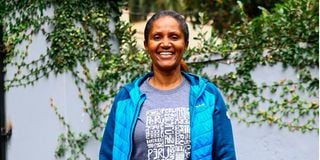
I meet Alice Ng’ang’a on a cold morning, and she is at home with her dogs. She has a slender, angular frame and a warm smile that lights up her face.
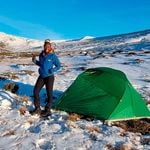
At 52, she is a wife and a mother of four. An adrenaline junkie, she delights in chasing altitude peak points all over the world, not to break records but simply to relax and unwind.
From climbing the corporate ladder in the marketing and advertising to becoming a rock-climbing and mountaineering virtuoso, Alice’s journey is one of slow treks laced with intermittent breaks of leaps and bounds.
Three years ago, Alice quit her job at ScanGroup to follow up on a promise she had made to herself that she didn’t want to be employed when she turned 50.
Having worked all her life, she rewarded herself with a six-week holiday shortly after exiting her marketing job.
She took a cruise across Europe, where she met a group of Kenyans who were planning to go on a hike. They invited her to join them and she brought her sister along. The hike was a 10-day tour across Switzerland, Italy and France (Tour Du Mont Blanc).
The adventure stirred up the thrill for hiking, one she had experienced before while in her 40s. Then, she was an amateur hiker, exploring Ngong Hills and, when she felt very adventurous, tackled Mount Longonot. Her best friend encouraged her to step out of her comfort zone with a four-day hike of Mt Kenya.
“I almost gave up before reaching the first summit. It was tough and super cold. I, however, wanted to make my friend proud because of the sacrifice she had made to accompany me there. She pushed me and eventually we reached the summit and from then, I never looked back,” she says.
“The peace you experience on a mountain is enough to make you forget all your problems and worries and it is so beautiful that I admonished myself for waiting until I was 40 to have my first proper hike,” she adds.
Three months after her maiden Mt Kenya hike, she was back again, this time taking a different route. The mountain had given her a connection with God. She felt light and free, yet also filled with an insatiable thirst for more.
“Lenana, where people usually go to hike, isn’t the highest point; it is less technical and easier to navigate. I have been to Nelion, which is harder to navigate. I was trying to get to Batian, which is the highest point, but I didn’t make it, and so we slept at Nelion on the rocks,” she says.
Once in a while, there is news of a zealous hiker losing their life on a cold trail, but this doesn’t seem to faze Alice’s passion.
“I don’t fear, people die everywhere, you can even die in your house, there is no exclusivity to places where one can die. Sometimes you go through treacherous paths, which are a slight slip from death, some I cannot even show my mother or husband because they would think I am spiralling off to crazy things, but I have confidence.
“I have no fear of heights. I have jumped out of planes, gone bungee jumping, paragliding and zip lining. I have done quite a number of extreme sports to make this almost a normalcy. If you have gone for bungee jumping between the border of Zambia and Zimbabwe, you would understand what I am talking about,” she says.
For someone who lives off one adrenaline rush after another, it is a paradox that Alice’s greatest fear is death, even though she lives and walks within inches of it at times. However, her fear of death is simply for the reason that she perceives herself as not having lived enough.
“I feel like I have so many years to live, there are so many things to do that I haven’t done,” she says.
Mountaineer Alice Ng’ang’a during an interview in Nairobi on July 8, 2025.
Photo credit: Wilfred Nyangaresi | Nation Media Group
Peak points
There are several peak points to conquer on Alice’s list. Mt Champaqui in Argentina is top of that list, for which she needs Sh1.5 million to make the journey.
She has been to the base camp of Mt Everest, but it doesn’t seem to flutter her heart. She lost a friend on this mountain, a topic she doesn’t dwell on much.
“There are places where people go to which I don’t feel like going to, for example, the top of Everest, is never on my list. What I love most is seeing nature during my hikes, my drive is not to break any record for scaling a specific height, but rather for self-fulfilment.
“Ruwenzori, in Uganda, is such a beautiful place that never gets enough mentions. It is a long hike, but it has one of the most serene trails I have ever experienced. It is undefiled by humans, you will find trails that no one has walked on for so long and old trees covered with moss.”
Alice has been to more high points than the number of fingers and toes you can count. Apart from Ruwenzori, she has hiked Sabyinyo in Uganda, which is part of the Virunga Mountains. In Rwanda, she has been to Karisimbi, Rwanda’s highest point in addition to Mt Gisoke.
In Tanzania, she has hiked Mt Kilimanjaro and Mt Meru. In Morocco, she has been to Mt Mutuka. She has also hiked at Machu Picchu in Peru, which she says is one of the best places to go practise mountain climbing due to its naturally high altitude. In Peru, nearly every town in Peru is a peak. She also visited Ras Dashen in Ethiopia and the Rainbow Mountain, which took a drive and a three-hour hike to get to its top.
Rock climbing
Of all her adventures, she says that the biggest challenge as geting visas to get into the different countries. Communication has also been a barrier in places where it’s hard to get a native who speaks English. In 2024, she had a tough time while in Pakistan, where she had visited three different places to hike due to a communication barrier.
“These days, everyone hikes. I have seen groups of women who hike all by themselves, I have also seen male groups and mixed groups too. This is a very good thing, and I think it helps in getting more people to know about the sport. The only thing I would love people to know more about is rock climbing. Kenyans are still behind because they are scared of it and associate it more with white people.”
Alice notes that rock climbing is an expensive sport compared o hiking, and its technical aspects are even more challenging. Although the interest is gaining, Alice, who also sells rock climbing gear, admits there is a need to popularise the sport more.
When she began hiking in earnest, Alice got her children interested, but only one daughter continued. She has peaked Lenana, on Mt Kenya. The other daughter dropped off, and her two sons prefer swimming. Her husband, she says, prefers walking and a softer life free from the harsh engagements with the natural elements.
Hiking can be expensive, especially when it comes to travelling across continents to chase altitude peaks.
“I save my money for going on hikes the same way people save up for parties or their hobbies. Day hikes cost between Sh2,000 to Sh4,000. It is the international ones that are costlier. When I was working, the money I got for bonuses or any other extra money went into the hiking trips. I always have a meticulous plan that has been effective. For rock climbing, it has been an investment done over time,” she says.
Her family feels her absence when she leaves, but it is something she says they have come to understand and support.
“A long time ago, I used to go hiking every Saturday, until my family complained that I wasn’t available. I had to adjust and be around more often. I would say that my family is very understanding, and they know that I am hooked on hiking. I let them know in advance when I have a hike coming up. Sometimes I am away for two weeks or more, but they tell me to do my thing.”
However, because she is unemployed, she finds herself spending all her time when she isn’t hiking with her family, telling stories of her hikes and avoiding her daughter’s dogs. Her family is actively outdoors. Nina, her daughter, is a better rock climber than she is and already wants to go places to explore. The boys swim, play football and hit the gym, her husband and her last-born daughter resolved to have it soft and take the occasional walk that wouldn’t break a leg.
Her advice to aspiring hikers and rock climbers? Always start small, good sports shoes are enough to start off with the simple hikes. To be able to afford the whole hiking and climbing gear takes time.
“If I am asked to wear my most expensive clothes for a dinner, I would probably wear my climbing gear,” she says with a laugh, “but it took a very long time to afford this,” she says.