Time flies with great content! Renew in to keep enjoying all our premium content.
Prime
Africa must seize China’s zero-tariff offer to grow manufacturing sector
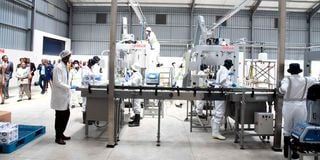
High Chem Industrial Park in Industrial Area, during the opening of new manufacturing units, with five lines of Reckitt products Jik and Harpic on November 29, 2022.
The African proverb “When elephants fight, it is the grass that suffers” has long captured the collateral damage of great power rivalries.
Today, as the US and China compete for global influence, Africa often finds itself caught in the middle—absorbing the ripple effects of decisions made far away. But this time, the grass need not suffer.
China’s recent decision to eliminate tariffs for 53 African countries presents a rare opportunity: a chance for Africa not to be trampled, but to rise. If seized wisely, this moment could mark a turning point in Africa’s shift from raw material exporter to value-added producer.
At the 2025 China-Africa Economic and Trade Expo, over 30,000 participants gathered to witness the signing of 176 projects worth $11.4 billion, with an additional $43 billion in cooperation opportunities announced. This is more than diplomacy; it’s a signal that Africa is being invited to play a bigger role in global trade.
Of course, this gesture is not without strategic benefit for China. Tariff elimination is a lever to secure long-term political goodwill, commercial influence, and access to Africa’s fast-growing markets and critical minerals.
The challenge for African governments is to ensure this generosity works both ways—not as dependency, but as leverage.
Yet trade data tells a cautionary tale. Between January and August 2025, China-Africa trade reached $222 billion, but Chinese exports to Africa surged 24.7 percent, while African exports grew only 2.3 percent.
The result: a $59.5 billion trade deficit. Africa continues to export raw materials and import high-value goods. This is a pattern that must change.
Kenya’s recent negotiations to convert $5 billion in Chinese loans from US dollars to yuan offer a glimpse of strategic recalibration.
Treasury Cabinet Secretary John Mbadi has said the shift could halve interest costs, with the conversion potentially reducing rates from 6.37 percent (USD terms) to around three percent under yuan terms.
This move is expected to ease fiscal pressure, reduce dollar dependency, and extend repayment terms—offering much-needed breathing room in a tightening global credit environment. It’s a bold step toward greater financial sovereignty and a sign that Africa can shape its own terms, even in the shadow of global power realignment.
But the real transformation lies in industrialisation. Across the continent, entrepreneurs are proving that Africa can export more than commodities. It can export quality, innovation, and resilience, as well.
Africa’s industrial future will not be built by tariffs alone. It will depend on bold policy choices and practical reforms that make local production viable and competitive.
That means investing in infrastructure and logistics to lower the cost of moving goods, reforming capital markets to unlock financing for small and medium enterprises, and structuring trade agreements that reward local value addition over raw exports.
It also requires deepening regional integration through initiatives like the African Continental Free Trade Area, so that African producers can scale beyond their borders.
China’s zero-tariff policy is a door. What lies beyond depends on how Africa walks through it and, whether this time, the grass chooses not just to survive, but to grow tall.
From cassava flour in West Africa to chili sauce in Rwanda, African entrepreneurs are building value chains that deliver nutrition, income, and resilience. In our work at Acumen, we’ve had the privilege of backing several of these pioneering businesses: transforming cassava into flour, starch, and snacks to boost farmer incomes; unlocking new markets for coconut oil and cosmetics in East Africa; improving nutrition through poultry ventures in Ethiopia; and enabling solar-powered cold storage in Kenya to reduce food loss and reach premium buyers.
These are not isolated success stories, they are signals of what’s possible when patient capital meets local ingenuity. While traditional aid is fading, catalytic concessional capital still has a critical role to play.
Smartly deployed, it can complement zero-tariff trade by helping entrepreneurs scale, invest in processing capacity, and compete globally. It’s not the aid itself that matters, but how it’s structured — and whom it empowers.
Africa’s industrial future will not be built by tariffs alone. It will depend on bold policy choices and practical reforms that make local production viable and competitive.
That means investing in infrastructure and logistics to lower the cost of moving goods, reforming capital markets to unlock financing for small and medium enterprises, and structuring trade agreements that reward local value addition over raw exports.
It also requires deepening regional integration through initiatives like the African Continental Free Trade Area, so that African producers can scale beyond their borders.
Governments must act with urgency to ensure that zero tariffs don’t simply open the floodgates to more imports, but instead catalyze the rise of African-made products and brands on the global stage. The shift from aid to trade is already underway. The question now is whether Africa will shape that future — or be shaped by it.
The writer is Africa Director, Acumen
Unlock a world of exclusive content today!Unlock a world of exclusive content today!